Home > VMware

VMware

VFD2 - Zerto

Friday, February 24, 2012 Category : , , , , , 2


The second vendor for day 1 of Virtualisation Tech Field Day #2 was Zerto

The session was held back at the hotel. The camera crew did not come back and this event was not broadcast over the Internet. To be honest I was a little confused about the what you can say, and what you can't say, discussion. There was going to be mention of some things which are coming out in the next version as well as some customer names. Both of these might be things that should not be in the public domain until appropriate. To be honest, this is difficult as a blogger and I thought there was some "understanding" with these events that everything was public, no NDAs. Whilst I respect a vendor wants to keep things private whilst balancing giving us the greatest insights and information, it makes it really difficult for me to navigate what I can and can't write about. So if I make a bad mistake treading that line I am sure someone will let me know in the morning and I will be editing this post very fast.

Our presenting were Gil Levonai who is the VP Marketing and Products and Oded Kedem, CTO & Co-founder. So we were really getting things from the experts.


Zerto do disaster recovery solutions for the VMware environment. Their target customers are the Enterprise and now the Service or Cloud providers. Having spent quite a few years working in the DR and recently the Cloud space I was very keen to hear what Zerto had to say.

Here is my summary notes for the session.
  • The founders were also the founders of Kashya Inc which was sold to EMC. After being sold to EMC Kashya turned into RecoverPoint which is one of the mainstream replication technologies for Continuous Data Protection (CDP) based DR today. 
  • They are more after the Enterprise market and not the SMB players. I have no idea what their pricing is like, I wonder if their pricing matches that market segmentation?
  • Replication of a workload can be of a number of scenarios. One is between internal sites within the same Enterprise. Alternatively you can go from within an Enterprise to an external Cloud provider. There is a third use case (which is very similar to the first) where a Cloud provide could us Zerto to replicate between their internal sites.
  • The fundamental principal for Zerto is moving the replication from the storage layer up to the hypervisor without loosing functionality. Essentially it is a CDP product in the nature of RecoverPoint or FalconStore Continuous Data Protector, but rather than being done at the storage or fabric layer it utilises the VMware SCSI Filter Driver (as detailed by Texiwill) to get up and close to the Virtual Machine. This means that Zerto can be totally agnostic to the physical storage that might be being used which is a great feature. This is important in the Cloud realm were the consumer and the provider might be running very different storage systems.
  • The goal of Zerto is to still keeping all of the Enterprise class functions such as consistency groups, point in time recovery, low RPOs and RTOs. The only obvious high end feature that I saw was lacking was synchronous replication. This question was asked and Gil responded that they felt that this was not really that much of a requirement these days and synchronous might not be required. I think their is still a case of needing synchronous but Zerto just does not seam to be wanting to go after it, which is fair enough.

  • There are two components (shown above). The Zerto Virtual Manager that sits with vCenter. This is the only thing that you interact with. It is provided as a windows package that you need to deploy on a server and it integrates to vCenter as a plugin.
  • Then there is the Zerto Virtual Replication Appliance (Linux based) which is required on each host. This is deployed by the manager. 
  • Some of the features of Zerto are :
    • Replication from anything to anything, its not reliant on any hardware layers, just VMware
    • Its highly scalable, being software based
    • It has an RPO in seconds, near sync (but not sync)
    • It has bandwidth optimisation and WAN resiliency. Built in WAN compression and throttling.
    • Built-in CDP which is journal based. 
    • It is policy based and understands consistency groups. You can set CDP timelines for retention in a intelligent way. 
    • If it gets behind and can't keep up it will drop from a send every write mode to a block change algorithm and drop writes in order to catch up. This catchup mode is only used if the replication can't keep up for some reason (lack of bandwidth, higher priority servers to be replicated. What I would like to see is for this to be a feature you can turn on. So rather than CDP you can pick a number of points in time that you want and writes between these are not replicated. This would emulate what occurs with SAN snapshots. Yes its not as protection but for lower tier workloads you might want to save the bandwidth, you can match what you might be doing with  SAN snapshots but can do it across vendor. Gil did not think this was a great idea but I think their is real merit to it, but I would, being my idea. 
  • Often people want to replicate the same workload to multiple sites. Sometime the same machine two different sites from the primary one (call this A to B and A to C), or from the primary to a secondary site and then a replication from the secondary site to a third site (A to B to C). You can't do either of these modes at the moment but watch this space. 
  • There is a concept of Virtual protection groups. VM and VMDK level consistency groups. This is very important for some applications which need to have data synchronised across multiple disks or across systems, its great to see this supported. 
  • Support for VMotion, Storage VMotion, HA, vApp. 
  • There are check points in the CDP stream every few second and you can set a time for doing a special VSS check point. This is excellent. 
  • Its vApp awareness is very good. If you add a VM to a vApp it will start replicating it. It also knows things like startup order within the vApp and retains that information for recovery at the other site. This is better then VMware Site Recovery Manager (SRM).
  • You can denote a volume as swap or scratch so its not replicated. It does replicate it once, just so it has the disk to be able to mount up to the OS. Once once replicated it does not send any writes made to the disk. This way you get a valid disk that will mount fine at the destination with the initial swap or scratch state. This is a great feature.
  • They will be able to pre-seed the destination disk at the other site to speed up the synchronisation, a big need in the DR space when you are dealing of very large amounts of bandwidth down restricted bandwidth pipes. 
  • There is no need for a shadow VM at the destination site. They are created on recovery or failover. At the failover the VMs are created and disks connected to it.
  • Failback is supported.
  • Test failover is provided and it can have read write capability. Replication continues to run while the test recovery is taking place (you always need to be protected). The test can't run longer than your CDP journal size. The test recovery is very efficient in storage size as it sources the reads from the replica journal and it does not have to create a full copy of the disk, so only your writes to the test copy take up additional space.
  • For the recovery migration you can do a move instead of a failover which does a shutdown of the VM first to give constancy.
  • For the failover you can choose the network to connect each nic to at the other site. You can specify different NICs for actual failover versus a test failover. It can also re-ip address the machine if required. 
  • Support the Nexus 1KV but as port groups. I don't think it can orchestrate network creation on the N1K.
  • Pre and post recovery scripts can be configured to run, so you can script actions to want ever you want, such as updating DNS entires etc.
  • Now the really really really nice thing is that you can destine to a VMware vCloud implementation. When you target to a vCloud you select which of your available organisation VDCs you want to recover to. Then, when you are selecting you networking, it presents the organisational Networks as your choices. Very nice. A demo was done or doing a failover to a VCD environment and it worked very nicely. I was quite impressed. I discussed with Oded how all of the provider side was handled, the multi-tennacy, security etc, just about everything had been covered an quickly explained. This showed to me that this stuff is very real and they have thought about this a lot. I see a lot of potential solutions for this that might work in a Enterprise space but that have no chance in the service provider space, but from what I could see I think Zerto gets it.
  • When you need to do a failover , what happens if the source site no longer exists. Well you go to the vCenter on the destination site and do it their. This is a problem in the Cloud space as the customers are not going to have access to the vCenter, only the provider. Today the provider is going to have to do the recovery for you if you your site is gone. Their is an API for the provider to use with their own portal. Ultimately Zerto are saying they will provide a stand alone interface to do this function. 
I really enjoyed the presentation for Gil and Oded. Not to many slides, a great demo, lots of explanation and really showing of what was unique about their offering. I am looking forward to learning more about what they are doing and in seeing their functionality grow, I think they have many things right in this new hybrid Cloud world.

Rodos

P.S. Note that I am at this event at the invite of GestaltIT and that flights and expenses are provided. There is also the occasional swag gift from the vendors. However I write what I want, and only if I feel like it. I write nice things and critical things when I feel it is warranted. 

Virtualization Field Day #2 / Silicon Valley- pre event

Wednesday, February 22, 2012 Category : , , , , 2

Well I have escaped from the wet and dreary shores of Sydney to spend some time geeking it up with the crew for the Virtualization Field Day #2. Having been to one of these events before I know just how much hard work and fun it can be. Its so great to hang out with people so smart in their field, plus to hear direct from the best people within the presenting vendors.

The activities start Wednesday night with a get together dinner. Thursday and Friday are all of the vendor presentations. I arrived this last Sunday to do a few days work of meeting before the event. Of course I had to do a bit of the usual Silicon Valley shop hop around some of the favourite haunts for all things geek.

One place I went today, that I had never thought of before, was to Apple HQ. Here is some guy who was wearing a suit, who wears a suit in the valley, only me!

Who's the stiff in the suit!
The cool thing is that there is a company store there. Its not like an Apple store. It has a lot more Apple merchandise. It also has a t-shirt that can only be purchased from the Apple campus store. Of course I had to get one.

Apple Company Store
Of course I also had to do a trip to Fry's and pick up something. Ended up getting a 4 port 1G switch for the home office. I am sick of 100Mb transfer speed between me and the Drobo storage device (which hangs off a Mac mini). Also some of those nice little pop up speakers for use in hotel rooms etc. This is on top of the other stuff I pre-shipped to my hotel, none of which has arrive yet. I pre shipped a bunch of t-shirts from ThinkGeek for the kids and a SSD drive for me.

One place I have never been to here in the US is In-N-Out burger. My American friends rave about it. So I had to check it out.
The back wall of In-N-Out burger, the view from the car park.
I had to go the whole hog and get a burger, fries and a shake. I am told the way to order your burger is "animal" style, which means it comes with (I think) sautéed onions and chilli. The person I was with sort of made a mistake and somehow also ordered their fries done "animal" style. Can you believe it, they actually do that. Here is what it looks like.


After eating mostly healthy food for about a year it was great to chow down on great fast food. This stuff is fresh, you have to wait for it to be cooked. The fries are cut from whole potatoes just before they are cooked. However my stomach rebelled about half an hour later, the temple had been defiled! But was worth it. Repeat after me, "In-N-Out is occasional food!".

But what is going to be really fun this week is hanging out with the old friends plus some new people at the field day. The attendees this year are Edward Haletky, Bill Hill, Mike Laverick, Dwayne Lessner, Scott Lowe, Roger Lund, Robert Novak, David Owen, Brandon Riley, Todd Scalzott, Rick Schlander and Chris Wahl. Some real who's who of virtualisation thinkers. 

The vendors this event are interesting, we have Symantec, Zerto, Xangati, PureStorage, Truebit.tv and Pivot3. Some big names their, some interesting new ones and great to see that I will get to hear the thoughtful words of Mr Backup himself, aka Mr W. Curtis Preston again. 

The only vendor I will call out specifically as sparking some very high interest from me pre event is Zerto. They have DR capabilities with full integration to VMware vCloud Director. As I deal daily with one of the leading deployments of vCloud Director in the service provider space this really gets my brain juices flowing. There is big interest in this topic and I am really keen to see exactly what these guys have. I want to separate the hype from the reality and really hope that the reality is an exciting story.

You can see the details of the whole event over at the Field Day site http://techfieldday.com/, the links page really gives you all the resources you need.  The sessions will be broadcast online and you can follow the tweet stream via the hashtag #VFD2. 

More updates as the events unfold.

Rodos

VMworld 2011 Keynote

Saturday, September 03, 2011 Category : , 0

Some of the best bits from VMworld are the keynotes. The first was by Paul Maritz, the CEO. Here are my notes from the presentation. You can view the video of it on the Internet. Paul is not the most dynamic speaker, he is no Chambers on that front. However is is recognised as one of, if not the, smartest.

Last year there was the tipping point of more new apps being deployed on Virtualisation over physical. This year its now more virtualized across the entire installed base! More than half of anything is import for an industry.
1 virtual machine is deployed every six seconds, more than 20 million VMs across the globe. There are more VMs in flight with vmotion than there are airplanes in flight. More than 800k admins, 68k vcps and done with the support of the application vendors.

Is the cloud just timesharing rediscovered? It's about three profound things. It's the next major interation in the consumerisation of IT.

It's the canonical applications that define the generation of computing. In the mainframe era it was book keeping. It the late 80s it moved to the consumer world. New users through personal computing, the GUI, Intel architecture and the relational db. This allowed a new set if applications, client server, the Internet. CRM and non real time analytics.

With the Cloud we will see a new set of applications and the industry will change. Billions of new users and devices coming into play. Three years ago most devices connected to the net were PCs. In three years it will be less than twenty percent will be PCs. HTML5 might have a big impact.
The Relational Database can't cope with this new world. We need customized information in real time, for the facebook consumer of today.

How do we go forward from here? Let's ring fence off the mainframe. But what do we do with the client server world and migrate it to the new Cloud era.

How do we make it more efficient to run those apps we can't walk away from. Then what do we do about the renewal of applications.

Apps were built around real paper or what was paper on the screen. We need application renewal.

Lastly users are expecting to see everything on a new set of devices that can't be controlled by IT, whatever device they have in their hand.

How do we allow infrastructure renewal for those client server apps. To get operational efficiency. Virt can do this in a non disruptive way which is why it has been so successful. We can't just make more operational tasks but rather create more automated efficiency.

They had to have overlapping development efforts to release a new release of vSphere each year. Twice as many man hours in Q&A than development. This is like building hardware and has the same importance. First time Paul has seen a major bit of software be released on time with all it's original function set.

The new version is starting to do with this operational automation. Storage load balancing and tiering, automated host provisioning. The new version results in great scale, resiliency and automation.

A new schedule of how releases will be done. Not just vSphere but all the elements to deliver functionality, such as security, disaster recovery and Cloud portals. New versions of SRM, Operations, vShield and Director.

There are many service providers one delivering Cloud with Director. Plus virtual clouds such as NYSE. The vCloud Data Center program has expanded. A subset is clubbing together to give a world wide available cloud, global connect.

New virtual storage appliance for the SMB to get advanced features.
VMware GO to be expanded with things like patch management.
Application renew is the big effort in front of us. The new apps will be done by those under 35. Last 5 to 8 years developers have resulted against complexity and have new environments and fabrics. Let's give them those on the same underlying fabric. They are not interested in the low level details, more of a PaaS. They are willing to give up some control.

VMware are putting these elements under vFabric. Keys off Spring and now starts to include data, with the acquisition of Gem. A scale out in memory database.

Now SQLfire which brings an easier programming model with the scalable nature of GemFire.

Data Director will manage the task of administration of these databases. It can do backup and all those things. It's vSphere aware. They have taken Postgress and optimized it's memory management for a virtual environment and it can get much better density.

Cloud Foundry is about how apps will be built in the future, those new modern programming frameworks. It's open source and the community has been extending it. It's designed to be portable across clouds. There is a danger of going back to the lack of application portability, the Cloud should not be like this. What will be the new cloaking layer between hardware and the cloud? This needs to run from the provider down to the developers desktop. Developing a version for a memory stick.

Lastly we need to give a way to give people access to the applications that they need, continuing to invest in VMware View and releasing View 5.0. There will be more clients available.

PCs are not the only device any more. The PC can't belong to just one person any more. Horizon is about association of functions to people and not a specific device. But you now need to map people's activities to a device. Such as giving a user a virtual phone.

The PC was about automating the white colar worker experience of 1975. Xerox PAC started it and apple and Microsoft took up. The new workers and not using documents, they are streaming, filtering, they are not from the folder and document world.

What about the 50 percent which are not virtualized? Got to tackle the mission critical applications. That's what vSphere5 was about. Then start to work on those new applications and new way of doing things.

End of presentation.

Rodos

DR to the Cloud with SRM

Tuesday, August 30, 2011 Category : , , , 0

I went to two sessions this morning on DR to the Cloud.

I think the first thing you could say about these sessions is that they were named a little wrong. They should have been about DR to "managed service provider" or "hosting company". There might have been a bit of Cloud washing going on here. There were certainly elements of clouds and this is a developing space of which we are at the start if the journey, but I think the topics may be a little "over sold" in their wording.

So what were my notes?

  • SRM will evolve to be application or vApp aware rather than it's VM centric nature of today.
  • Today SRM is all about protecting a machine in site A in another site B. In the future there will be more sites involved, protecting works in one site to multiple sites. For example you might protect a machine to your internal second site plus an external Cloud provider.
  • VMware are working on creating layer two connectivity between multiple sites. This combined with VMotion across sites will allow some interesting DR scenarios. In my opinion this will be helpful for disaster avoidance.
  • The goad is to be able to intermix vSphere and vCloud Director as either sources or destinations of DR.
  • There is the use case of DR to the cloud as well as DR off the cloud.
  • The plan is their would be a plugin for your vSphere Client that would do all the work of setting up DR to a Cloud provider. I imagine this would be like the vCloud Connector plugin.
  • The attributes that are proposed for this future state of software are; VM level protection granularity, multi-tenancy, self serviceability, storage agnostic, vm portability, role based management, scalability, extensibility, simplified deployment and management, security and RAS (reliability, serviceability and availability).
  • Hosting.com described their use of SRM 5 to provide Cloud DR. From what I could see this looked like an implementation of SRM on top of a vSphere implementation that had a Cloud front end. They have their portal for consuming virtual machines in a Cloud manner. By adding SRM underneath and then using the SRM APIs to control it from their portal they are able to give DR functions to users. This shows what can be done when you build your own world and don't use vCloud Director. The service is in Beta.
  • A question was asked from the audience about when SRM and vCloud Director would be integrated or compatible. The answer was that thus was in the roadmap but no detail. I suspect this person was like a lot in the audience was wondering about this given the title of the session.
  • In the service provider session a number of organizations got up and spoke about their DR solutions and how they were integrating in SRM. There was a lot of managed services wrapped around these. Lots of array based replication, customer specific ESX clusters and other such non-Cloud scenarios. There is certainly some great solutions out there and the providers are working hard with what they have.

What was my take away from two hours of presentation of SRM and Cloud. Essentially we are not there yet. Yes there are some DR solutions and some providers will even let you use SRM. The true cloud experience DR from your own infrastructure into a VMware based Cloud is there in parts but there is still portions of string and sticky tape holding all together. Actually that is probably not fair, it makes them sound unstable. What we don't have is the simplicity that we have with SRM today.

The question is, how long will it take for VMware and the providers to get there. I suspect 12 months, problem is we are greedy and want it all TODAY!

Rodos

P.S. Slowly getting used to Blogsy on the iPad to write this stuff up. Doing straight content is a lot easier than pulling things in from multiple places.

vCloud Global Connect

Category : , , 2

There were announcements out today about the new VMware Global Connect.
The announcement and blog detail out a relationship between a number of the vCloud Data Center providers.

VMware and its partners will accelerate the journey to the enterprise hybrid cloud with:

Global Connect – Multiple service providers, multiple geographies; a single global cloud
First introduced in August 2010, VMware vCloud Datacenter Services are enterprise-class public clouds built on VMware cloud infrastructure, including VMware vSphere®, VMware vShield™ and VMware vCloud Director™. Certified by VMware and offering globally consistent management and security, this network of service providers is expected to span 25 datacenters in 13 countries by the end of 2011. Today VMware and its partners are introducing Global Connect, an optional feature of the vCloud Datacenter service that will allow customers to use cloud services from multiple providers across geographies as if they are a single, virtual cloud. Bluelock, SingTel and Softbank Telecomare expected to be the first providers to offer Global Connect services.

For multinational customers that require high performance (low-latency), highly available cloud computing local to the countries where they operate, Global Connect will give them an easier way to address compliance with international regulations for data privacy, locality and confidentiality. Customers will work directly with their local vCloud Datacenter service provider, who orchestrates service delivery internationally with Global Connect, allowing customers to seamlessly leverage services from connected providers with a single contract and “single pane of glass” management across clouds using vCloud Connector.
You can see the reasoning behind this alliance. Amazon has their availability zones, but what if there is not one where you want it, how do VMware complete with this "feature" when it's something that is part of implementation and not the software so to speak. This expansion of the vCloud Data Center program gives customers the ability to access multiple clouds with assurance over comparability and service levels with the simplicity of a single entity.

You can see the service providers extending and becoming part of this. After all the telcos already do this on roaming and a lot of the organizations already have joint hosting agreements to cover regions where they do not have coverage. This maturity is collaboration can be brought to bear on Cloud services.

I think this is great for customers as well as being a good move by VMware and it's partners.

Rodos

P.S. Disclaimer, I work for a subsidiary of SingTel which is one of the member companies. Personal blog and views of course.

Alumni Lounge

Category : , 0

Hanging at the Alumni lounge at VMworld. After five years you would think that my status would be sorted but each year I always seam to have to queue to get the status applied. Not to worry, the registration people are very nice.

Cant see any food in here, just some water. I think last year there were some snacks. Their is quiet, power outlets and comfy chairs. A good place to hang to do some blogging before the solutions exchange opens later this afternoon.

Rodos

IE9 and VMware vCloud Director

Tuesday, August 16, 2011 Category : , 4

A quick note as people are starting to use IE9.

Currently vCloud Director (remote console plug-in) does not support IE9, the vCloud Director website should work with the appropriate Flash plugin, but the VMRC (console) is not expected to work. Support for IE9 is a feature request VMware are looking at for a future release of vCloud Director. Personally I am keen for Safari support too.

You can find the list of supported browser versions on various OS versions starting on page 18 of the install guide. Note that the Users Guide for VCD is less helpful as the phrase "At least Internet Explorer 7" which might lead you to think that IE9 works.

Rodos

Is VMware the new Tall Poppy?

Wednesday, August 10, 2011 Category : 6

Here in Australia we have this phrase called "The Tall Poppy Syndrome". It is the "social phenomenon in which people of genuine merit are resented, attacked, cut down, or criticised because their talents or achievements elevate them above or distinguish them from their peers."

Seeing a bit of the fallout of the VMware licensing for v5 I wondered if VMware were the new Microsoft and we felt that they just needed to be brought down a peg or two.

My view is that part of this is due to a cultural change in how Virtualization is used within organizations today. Back in the day VMware was used to remove other costs within a project, it helped drive the ROI. Due to consolidation, which was it's big use case, every dollar you spent on VMware licenses was saving you many other dollars on physical hardware. We would drive every cent out of that physical hardware but the VMware portion looked like good value for money.

In today's world we have moved onto new models. We have seen "virtual first" become standard (certainly in my region) and VMware be a standard base cost for doing IT. At the same time we have seen the base hypervisor become a commodity item. Therefore the hypervisor has become like all the other elements of a solution, people need to squeeze every spare cent out of it, just like their storage, networking and compute hardware. VMware has entered main stream and is being treated accordingly by consumers.

Yet to stay leader of the pack and continue to deliver the eco system of products and tools around the base hypervisor VMware need to recoup their costs and they are going to price accordingly.

My take on the pricing backlash is this is more about VMware being treated just like all the other products and vendors in the stack. The glory days of consolidation savings are over, it's now the new norm. Time to refresh the value prop and get used to the backlash no matter what they do, just like Microsoft.

Rodos

P.S. First post from my new iPad. Maybe this might get me posting more.

Congrats to Channel vChampions

Thursday, April 07, 2011 Category : , 0

Congratulations to all the VMware Channel Champions which were announced at the VMware Partner Exchange in Sydney yesterday.

The announcement was made by the new Channel Director for VMware ANZ John Donovan during the opening session.

Here is the list of 26 people that were named, which includes yours truly.


I know quite a few people on that list and have been working with many of them in the virtualisation industry for many years. Even though we are competitors I have always found a great spirit of shared mission and values with these guys where our business competition is left to the side where appropriate.

The people are called vChampions and all come from the partner community which is different from the vExperts. To be honest we don't really know much about it yet, there is a special event to reveal more details. There is a website (yet another one) http://www.vmwarechampions.com.au/ which states that
Welcome to the VMware Champions community.

The Champions community is a new initiative that will bring together the most dedicated supporters of VMware products, like yourself, and reward you with exclusive events and updates. We look forward to building a great future with you.
From what I have heard its intended that the program gives you access to some special events and more access to VMware staff. Time will tell.

Great that VMware is working to look after its community of people who participate from the Partner community and recognise leaders. Again, my congratulations to all who have been recognised!

Rodos

Enginuity 5875 after 5 months of waiting

Tuesday, January 04, 2011 Category : , , 0

After 5 months of waiting EMC have finally released Enginuity update 5875 for the VMAX.

Nigel Poulton has a great detailed writeup with all the details. I won't repeat everything here.

If you log into your EMC Powerlink you can see the release notes.


We first heard about 5875 5 months ago when VMware released vSphere 4.1. One of the neat features in 4.1 is being able to offload to hardware certain storage operations via VAAI. Chad posted the "good/bad/ugly" about EMC support for 4.1 on July 13 in 2010. Its here we learned that VMAX would not be supported for VAAI until this Enginuity release. It was certainly one of the ugly points in the post. My gut tells me that the VAAI functions probably got caught up on the code train for the deeper FAST technologies which took a lot longer.

A good thing is that with an Enginuity code update you don't need to do much work apart from contacting EMC support who then do the update remotely.


Rodos

Rod Johnson in top 5 for Oz IT in 2010

Category : , 0

Rod Johnson (of VMware / SpringSource) has been recognised in the top 5 people that had an impact for Australian IT in 2010.
The list was put together by reporter Brett Winterford of IT News.

Here is what the article says on Rod (but go read it at the source too).

A relative unknown outside open source circles until late last year, Sydney-bred Rod Johnson built an open source business that he sold to virtualisation giant VMware for a solid A$505 million in August 2009.

But Johnson didn't spend 2010 counting his riches. Under VMware, Springsource has grown from strength to strength, acquiring Gemstone and Rabbit Technologies and signing a joint venture with Salesforce.com.

Johnson now heads a team that is at the forefront of offering platform-as-a-service. He has also become a noteworthy speaker on the events circuit, offering advice to other Australian software entrepreneurs.

Great to see Rod recognised in this way. I met Rod in person at the CTO event for vExperts at VMworld last year (2010). Apart from making bit of a fool of myself with verbal gibberish (I was a little star struck) I did say that there were many in Australia who looked up to Rod as great example in the Australian IT industry. Rod was a bit perplexed at the comment. Its good to see that I am not alone in that thought.

Rodos

vForum LiveBlog for Day 2 Keynote

Wednesday, October 27, 2010 Category : , 0

If the technology comes together I hope to live blog the keynote from Day 2 at Sydney vForum.


Feel free to join the conversation.

Rodos

vForum Sydney Solution Exchange Booth Awards

Tuesday, October 26, 2010 Category : , , , , 0

In the tradition of social media we bring you the first ever (and possibly last) vForum booth awards. Success is based on a top secret criteria of awarding points in several random and sarcastic categories, as well as a little honest opinion.

Rodney Haywood and Alastair Cooke (@DemitasseNZ /www.demitasse.co.nz ) have dedicated minutes of their time to bringing you the best and worst of the booths, saving your the arduous journey through the crowds.

In no particular order, our awardees are:

Dedication to Booth Duty Award

Not a booth award, this is a personal award for the person who has shown outstanding effort above and beyond the call of duty.

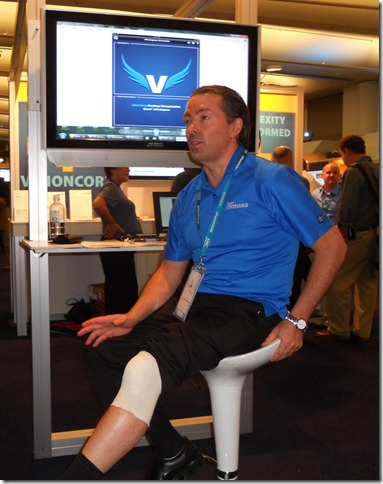
David Caddick of Quest Software wins this award for still coming to, and standing, at the Quest booth all day, after requiring four stitches in his leg this morning. David’s enthusiasm for an early jog lead him to a lacerating encounter with the back stairs.

Well done David for not giving up and being there.

The Is There Anybody Home Award

This award recognises the booth that is there but fails to deliver a visible presence of life. Is there a positive message from having a booth with nothing to deliver your message?

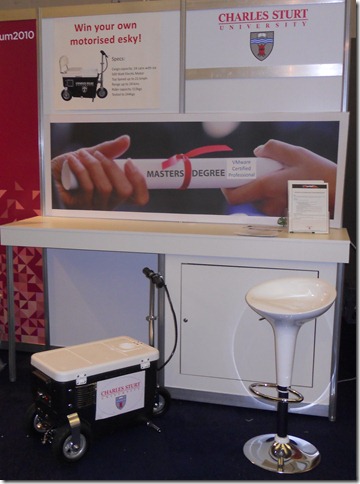
Charles Sturt university wins this award for the apparent absence of life or anything informative (apart from a mobile Esky). The presence of cold beer in said Esky would have removed this booth from eligibility for this award, alas it was a case of a pub with no beer.

Thank you, come again.

The Puritan’s Booth Babe Award.

This award is inspired by Thomas Dureya’s annual effort to decrease the amount of clothing worn by vForum Booth Babes. Our puritan family values cannot condone the use of the scantily clad female form in a male dominated event as a marketing tool, hence our award goes to the Booth Babes presenting the height of puritan values.

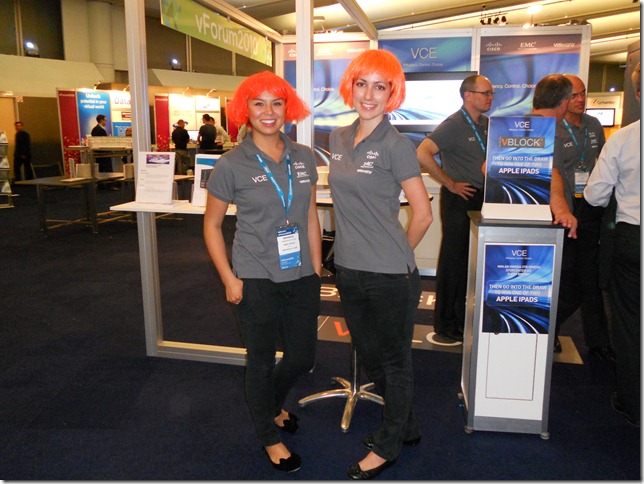
The award goes to the VCE booth where the Booth Babes were covered from ankle to neck, along with modest head coverings. This is an excellent representation of Slip, Slop, Slap that would survive even a summers day on Bondi Beach.

We are very pleased to see a number of women on booths with excellent technical knowledge, not simply Booth Babes.

Show Me The Hardware Award

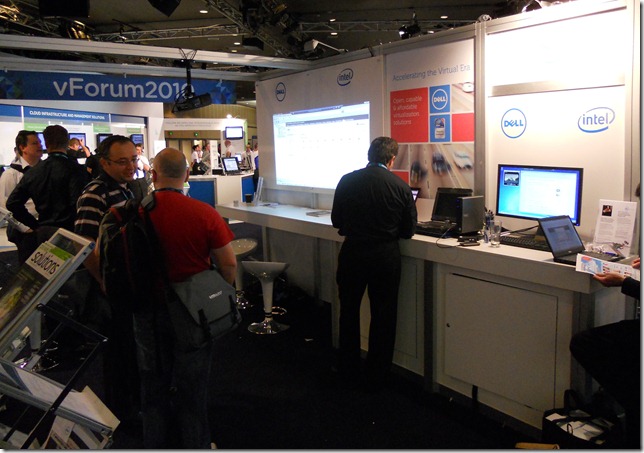
This award is to recognise the hardware vendor who has failed to show their product. Attendees are all interested in viewing and discussing your wares, which is hard if there is only a brochure.

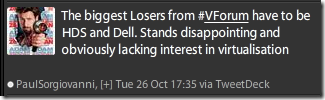
The award goes to Dell, one of the largest server and storage hardware vendors, who only had a few laptops on their stand showing powerpoint. We were not the only critics to notice the lack of tin.

Maybe it’s all in the cloud.

Bravery Award

This award goes to a vendor that has gone the furthest and taken the risks. The unkind could call them cowboys, but we call them courageous.

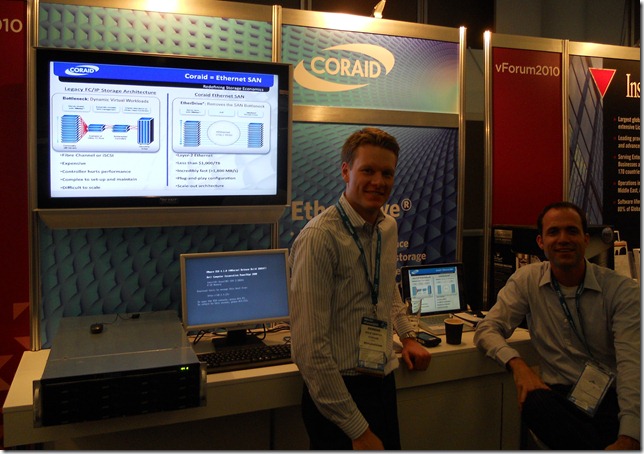
The award goes to the brave boys at CoRAID, a new entrant into the storage market in Australia. With little local sales presence and only imminent VMware HCL support they nonetheless braved the big money vendors and brought actual hardware with blinking lights. Great to see them giving it a go in this crowded space.

Bigger and better next year.

Interactive Playground Award

This award is for the booth where the geeks got to play. vForum is for engaging and learning, this award celebrates booths that do this well.

The award goes to Cisco whose booth had a structured schedule of open briefings on their products, with excellent giveaways. There were a number of blades to touch and look at their insides, the hardware wasn’t just there it was there to be investigated. There were numerous technical people who sought questions to answer.

Geeks delivering to Geeks.

Buffet Award

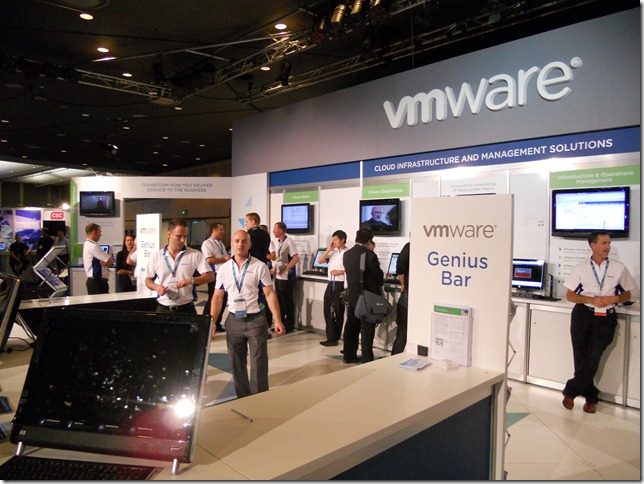
This award recognises the booth with the broadest range of products and solutions visible. There needs to be something for everyone and the whole family should go home having had their fill.

The award goes to VMware who, despite being their event, showed an enormous range of products at a detailed level, every product was actually there to be touched and used. More than a dozen products were identifiable from distance and there were experts on them all.

No one trick Pony.

Most Appealing Booth Award

This award recognises the booth that stands out and draws you to it, with so many booths it becomes a blur. Something different must greet the eye.

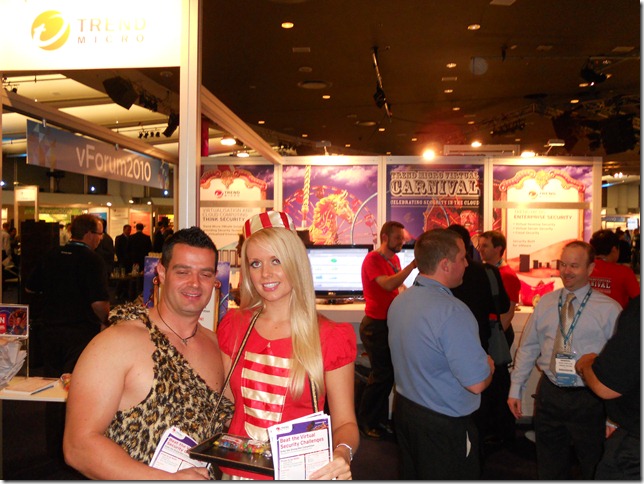
The award goes to Trend Micro for their appealing Carnival theme, from a distance you could see it wasn’t your ordinary booth. With the space limitations and sundry restrictions placed by event organisers it takes effort to stand out.

Who says conferences are all a circus?

Thanks to all the exhibitors who make the event so valuable. Congratulations to the winners. All those that didn’t make this years list should be planning for next year’s awards.

Rodos and Alastair

Automating the vCloud API with F5

Thursday, September 23, 2010 Category : , , 3

Now that VMware vCloud Director is out in the wild we are going to see lots of clever use of the vCloud API.


An obvious and very natural use case is Cloud bursting which really shows the power of hybrid Cloud. F5 Networks have some great technologies to stitch all of this together.

Here is a video of using F5 technologies to burst in and out of the Cloud using the vCloud API. If your application can support this horizontal scaling, its a great use case.


Rodos

CORAID

Tuesday, September 07, 2010 Category : , , 1

You meet some interesting vendors on the show floor at VMworld. One I ran into was CORAID, who have an interesting idea of not using Fibre Channel or iSCSI as the transport for storage connectivity, instead they use ATA over Ethernet (AoE). Certainly something I had not heard of before, but with all the noise around FCoE and FCoTR why not AoE.


By using commodity hardware and lightweight Ethernet vendors like CORAID can reduce the cost of deploying storage arrays. They have a range of hardware, although they don't have certification on the VMware HCL yet. I believe certification is coming soon.

CORAID have some interesting founders who have come from such places as VMware and Kidaro.

The main reason I wanted to mention them was because they are going to be present at VMware vForum in Sydney Australia on October 26th to 27th. If you are going along why don't you check out CORAID are all about. Its great to see these vendors which you come across in the US starting to take interest in Australia and attending the local conferences.

Rodos

Maritz on vCloud Datacenter

Wednesday, September 01, 2010 Category : , , 1

At VMworld yesterday Paul Maritz hosted a supper session after the keynote to explain more about the VMware vCloud Datacenter program.


Here are the session details.

Session Title:Public Cloud Computing Gets Real: Announcing New Enterprise-Class Service that Delivers on the Promise of Cloud Computing
Schedule Information: Tuesday, 12:30 PM (Room: Moscone North Room 134)
US Speaker:Kiran Sanghi Virtualization Strategist
Teradata Corporation
Bob Evans Senior Vice President
InformationWeek
Paul Maritz President and Chief Executive Officer
VMware, Inc.
Bill Chang Executive Vice President of Business
SingTel
Kerry Bailey Chief Marketing Officer
Verizon Business
Bates Turpen Senior Vice President, Technical Operations – Global Technology
InterContinental Hotels Group
James Johnson Senior Vice President, Global Technology Services
LAMCO
Length:60 minutes


Abstract:VMware CEO, Paul Maritz, will be discussing VMware’s newly announced cloud technology and how it’s being used as the foundation for a secure, high-performance vCloud service that is being introduced by leading service providers around the globe. Paul will be joined by key service provider partners that are delivering this new class of service, as well as enterprise customers who are at the forefront in leveraging public cloud services. In this session, you’ll learn how cloud computing is evolving traditional IT environments, making them more agile, secure and flexible.

It was a great session it was good to hear from the providers and customers on the program. Here is a video which includes most of the session.


Rodos

Disclaimer : I work for a subsidiary of SingTel who were one of the panel participants. Either way, it was still a good session with great information from speakers.

VMware vCloud Director

Category : , 0

Well today was a big day at VMworld as well as for my own activities. After much speculation and waiting VMware have now released a Cloud product, yes project Redwood has gone GA.


Like me you may remember VMworld 2008 where VMware first put out their vision for Cloud. I have been blogging about it ever since my first post on the topic on Sept 23rd 2008. Like me you probably remember being disappointed that in 2009 the only thing released was vCloud Express which was not really a product but a program.

Today all of that has changed both for VMware and me. VMware actually launched a product, VMware vCloud Director (VCD) plus a new program called vCloud Datacenter.

First the product, VMware vCloud Director.

I have been working with VCD since before the beta. In fact, as far as I know, we were the first people on the planet to install VCD outside of VMware (we just beat one other company who had the alpha code). Since then we have been through the beta program and have been keenly awaiting the released version. Its been a long road but it means that we are very intimate with the product and have been able to gain lots of operational experience. We have been running some beta trials with some of our own customers on top of VCD to get some field experience for ourselves as well as VMware.

Over the next weeks you will probably see information coming out about VCD, for the moment check out the product pages on the VMware website and I would recommend looking at some of the "Meet the Engineers" videos in the resources page. There are some great sessions on VCD at VMworld alongside the mystery Lab 13 which will show you how to do a quick installation of the product.

Second the program, vCloud Datacenter.

Here is how the VMware press release describes the program.
While public cloud services have created an alternative for delivering compute capacity in a self-service, pay-per-use model, security concerns, uncertain SLAs, lack of compliance and fears of lock-in have limited enterprise adoption. VMware vCloud Datacenter Services provide a way for enterprises to extend their datacenters to external clouds, while preserving security, compliance and quality of service. Delivered by some of the world’s leading service providers, including Bluelock, Colt, SingTel, Terremark and Verizon, VMware vCloud Datacenter Services will use globally consistent infrastructure, management and security models to make it possible for enterprise customers to move computing workloads from internal virtualized infrastructure to an external cloud and back.
You can see that there are five providers that cross major parts of the globe. This includes SingTel, which is the parent company of Optus who owns my company Alphawest. It is great to be part of the program. However I prefer how it was quoted in the press.
Balkansky expects only a "few dozen" partners globally would be certified as 'vCloud Datacenter Service Providers'.

"We needed to have a best of the best, a quality set of partners we could go with jointly to our customers," said VMware CEO Paul Maritz.
So what this means is that VCD is a product from VMware. Anyone can go and purchase it to build an internal or a public Cloud (subject to licensing programs of course). But VMware have worked very closely with a select few providers, especially in this early stage of the product to provide some consistency and assurance around the services that are offered for external Cloud.

As the Principal Architect for a major deployment of VCD in Australia which will be launched sometime in the future (I am of course not allowed to say when) I am very pleased to have the product and the program now publicly available. I have had a few people comment about my lack of blog posts over the last year and I can tell you its been quite frustrating. Much of what people blog about is what you interact with on a day to day basis and for so long everything I have been doing has been under heavy NDA so I just have not been able to talk about it. Today is not the day to be doing deep dives into VCD, I will do that over the coming weeks as I share my likes and dislikes of the product.

Essentially today has been a day to celebrate the end of a long journey for many. It was good to see Eddie Dinel, the product manager for VCD on stage during the keynote. I managed to catch up with the development team as they celebrated tonight the end of their hard work. Here are some photos from the event.


Left to right are some very important people that I have worked with closely on all of this.

Rodos (thats me), Principal Architect - Datacenter and Cloud, Alphawest.
Eddie Dinel, Product Manager for VCD, VMware. Eddie was on stage during the keynote.
Mike DiPetrillo, Principal Systems Engineer, Global Cloud Architect, VMware.
Phil Weiss, vCloud Solutions Architect APAC, VMware.

I also got to meet some of the developers who were let out of their cages. Below is a photo of a team member who worked on the UI experience and a programer who worked on the UI plus a number of other areas.


Now its time for some sleep. VMworld has two more days. I look forward to VCD getting out in the wild, its a good thing for the Cloud market to have some new options and player coming to market.

Rodos

P.S. I don't speak for my employer, this is my personal views and comments. If you are press and you want any comments, contact the media department at my company. If you are a blogger, a virtualisation geek or someone thinking of deploying VCD as a private or public cloud I would be more than happy to discuss with you my experiences of building and deploying one of the first global implementations.

Get yourself to VMworld FREE

Thursday, August 05, 2010 Category : , , 1

Want to get yourself to VMworld San Francisco but can't convince your boss or afford to drag yourself there under your own steam?


Well here is your chance to win a free conference ticket, plus the accommodation and airfare. The airfare can be international so all you Australians out there, this one is for you too!


The prize is being organised by Gestalt IT and sponsorship is being provided by Xsigo and Symantec!

All the details are over at the post "Announcing the Gestalt IT “Get Away to VMworld” Contest!".

The winner will be picked by a group of judges (I am one) based on how well you plan to "pay it forward" from your win. Describe how you will share your enthusiasm for VMware, virtualisation or whatever its is you are into as a result of your visit to VMworld.

This is my 5th year in a row at VMworld so I can attest its the biggest geek fest and party of the year. So get your entry in and I might just see you there!

Good luck.

Rodos


Gestalt IT TechFieldDay Seattle - Nimble Storage

Tuesday, July 20, 2010 Category : , , 0

Take a pile of smart just with backgrounds from Sun, Netapp and Data Domain, throw in a few PHDs (I assume) and see what falls out; thats Nimble Storage who launched at Gestalt IT TechFieldDay Seattle.

The company was formed in 2008, based in San Jose. The two founders are

  • Varun Mehta (Sun, NetApp, Data Domain)
  • Umesh Maheshwari (Data Domain)
They have some interesting people on their board of directors as well
  • Suresh Vasudevan (Omneon, NetApp, McKinsey)
  • Kirk Bowman (Equallogic, VMware, Inktomi)
Nimble call their technology game-changing, taking what was available in separate products and putting it all into one. Nimble coverage of iSCSI primary storage, backup storage and disaster recovery in a new architecture that combines FLASH and high capacity low cost SATA in a new way.

This brings FLASH into the range of many enterprises who would like to use it for more common workloads like Exchange, SQL and VMware. Their target is for organisations with 200 to 2000 employees.

Nimbles competition in the iSCSI market with market sizes (from IDC) are Equallogic who have 35%, EMC 15%, HP and Netapp are around 10% each.

Nimble have done the brave thing and started with a clean sheet of paper to try and create something that no one else can deliver.

The problems they are trying to solve are delivering fast performance without all those expensive disks and how to efficiently back it all up plus replicate that data to a second site for continuity purposes.

Techniques include
  • capacity optimised snapshots rather than backups
  • FLASH is used to give great performance
  • replication that is efficient and based on the primary information so that the time to recover and use that data is very quick, you don't need to wait for a resto
A key think that Nimble bring is their CASL architecture, it provides the following :
  • Inline Compression. A real time compression engine as data comes in. On primary datasets they are seeing about a 2:1 saving and on things like databases a 4:1 saving. Blocks are variable in sizes and Nimble take advantage of the current state of multi-core processors having a highly threaded software architecture.

  • Large Adaptive Flash Cache. Flash as a caching layer, starting at 3/4 of a TB for the entry box. They store a copy of all frequently access data, but all data is also storage on the cheaper SATA storage as well.

  • High-Capacity Disk storage. Using large SATA drives.

  • Integrated Backup. 60 to 90 days worth of "delta compressed incremental snapshots" can be stored on the system. They have put a lot of work into integration with Microsoft applications, integrating the VSS for ensuring consistency. The snapshot efficiency should remove the requirement for a secondary backup system outside of the primary storage. Combine this with replication to a remote site and you have a protected system.

    Nimble showed the results of some testing they performed on a Exchange 2010 19GB database running snaps over 10 days, the other vendor (Equallogic at a guess) consumed over 100GB of data whereas Nimble only consumed 3GB. A 35x improvement was claimed. This then results in less to replicate. Its suspected that the reason for this difference is the smaller and variable blocksize that Nimble can use, the competitor has a large blocksize.

  • Replication. The replication is point in time snapshot replication. Once nice thing that you can do is maintain different retention periods at each site. For example you might want to maintain a much higher frequency of snaps locally and a less frequent but longer tail of snaps over at DR, very nice. They have a VMware Site Recovery Manager (SRM) plugin in development but it has not been certified yet. Today you can't cascade replication but it will be coming in a future release. Cascade my be important for people who want to use the Nimble for backup, replicate locally and then offsite.
The befits that result from CASL are :
  • Enhanced enterprise application performance
  • Instant local backups and restores with fast offsite DR
  • Eliminates high RPM drives, EFDs, separate disk-based backup solution
  • 60%+ lower costs than existing solutions
When you create volumes they can be tuned for various application types, tweaking such things as page size or if it should be cached. The Nimble ships with a set of predefined templates for popular appellations. The same for snapshot policies which can be templates and a predefined set are provided.

The pricing estimates they have done is at under $3 per Gb for primary storage at an entry price of around $50K.

Here is the specs of the units.


There is no 10GB interface option yet but it will be considered on customer demand. The same goes for having a Fiber Channel interface. The controllers are active, passive on a system (not LUN) basis.

They currently have 10 to 12 beta accounts.

Umesh Maheshwari then have some further details on the technology behind Nimble. A great discussion from someone who knows the industry and the technologies, as you would expect.

Nimble is all about having the
  • capacity to store backups (through hi-capacity disks, compression and block sharing) along with
  • random IO performance for primary storage (through Flash cache for random reads and sequentialized random writes)
This technique of sequentialized was developed by Mendel Rosenblum in his PHD thesis in 1991 (see paper). If you don't remember Mendel was one of the founding brains behind VMware so his ideas have a good track record. Its called a Log Structured File System.

So why has this been done before, well it took technology a while to catch up to the idea. The original concept relies on the assumption that files are cached in main memory and that increasing memory sizes will make the caches more and more effective at satisfying read requests, hence the disk traffic will become dominated by writes. With only small amounts of RAM available it was a problem. Secondly the process requires a background job to do garbage collection.

Nimble have created CASL, an implementation of the log based file system. It utilises a large amount of FLASH for the cache and its integrated closely into the disk based file system. The index or metadata of the system is cached in the Flash and therefore the garbage collection can now work efficiently. Of course cache is bit of a simple word for what it does, its not a LRU, there is some complex meta data being tracked for performance.

The second element is the sequential layout of the data on the disks. How you store data on disk could be categorised into 3 different techniques.

1. Write in place. eg. EMC, EqualLogic
  • its a very simple layout, you don't need lots of indexes.
  • reads can go quite well
  • poor at random writes
  • parity RAID makes it worse
2. Write anywhere. eg. Netapp WAFL (write anywhere file layout)
  • more write optimised
  • between full stripes and random writes
  • its write a sequence of writes wherever there is free space. So when you starts is sequential but after a while the spaces that are free will be fragmented so you end up doing random writes
3. Write sequently. eg DataDomain, Nimble CASL
  • most write optimised
  • always do you writes in full stripes
  • good when writing to RAID
  • the blocks can now be variable size which is very efficient but it has a secondary effect that you now have room to store some metadata about the block such as a checksum
  • this requires the garbage collection process which runs in idle times to always ensure there is space available for writing full stripes, what makes this work is that the index is in Flash and the power of the current set of processors
  • the difference between what DataDomain do and CASL is that DD do their sharing based on hashes and CASL does it based on snapshots
Of course this makes you wonder whats the difference between the CASL cache and what many other providers are doing with a Tier of Flash?
  • Because the cache is backed by disk (the data is in the cache and on the disk) you don't need to protect the data on the disk. This means you can use cheaper flash drives and you don't need to do any parity or mirroring giving you saving of 1.3 to 2 times.
  • Its much easier to evict or throw away data in the cache than it is to demote data out of a Flash tier into a lower one, you don't have to copy any data.
  • You don't have to be so careful about putting things in cache as its not an expensive operation so all writes or reads can be put in cache for fast access if you need it again and of course cache is a lot more effort to integrate into your file system than tiering so if you are dealing with legacy its much harder then when you are starting from scratch like Nimble have.
Thoughts?

I really got the feeling that Nimble are not trying to be everything to everyone. They are focused on a particular market segment, hitting their pain points and attempting to do it better than the incumbents are.

They have a few things to deliver in my opinion to reach the goal, such as
  • cascaded replication to offer true local and remote data protection
  • get the SRM module for VMware certified
  • its looks hard to scale out if you just need some further storage as you can't add disk shelves, you get what you get. Yet their is nothing in their architecture to preclude some changes here which is good.
The big question will be is it different enough to the competitors for them to get into the market. If you only difference is doing something better (no matter how clever it is under the hood) how easy is it for your competitors to be "good enough" or a much better price point. Some good marketing, sales force and channel are going to be key.

With CASL, Nimble certainly have some very nice technology, but nice technology does not always win in the market. Its certainly going to be great to see how their early adopters go and how they adjust the hardware range and feature set over the next 12 months!

Note that its not available in Australia or EMEA yet.

Rodos

Note : Tech Field Day is a sponsored event. Although I receive no direct compensation and take personal leave to attend, all event expenses are paid by the sponsors through Gestalt IT Media LLC. No editorial control is exerted over me and I write what I want, if I want, when I want and how I want.

Powered by Blogger.