Home > Dell

Dell

Save the date for IIIS event in August

Thursday, May 19, 2011 Category : , , , , , , , , 0

If you are based in Australia then put a note in your calendar for August 2nd and 3rd. This is the date of the first Implementing Information Infrastructure Symposium (IIIS) which will be held at the Hilton Hotel in Sydney. The event is partnership between Storage Networking Industry Association for Australia and New Zealand (SNIA ANZ) and IDG Australia.


The first round of vendors have signed up as premier partners for the event, being :
  • Cisco
  • Dell
  • EMC
  • HDS
  • HP
  • IBM
  • NetApp and
  • Symantec
There means there is going to be some great information and speakers available. However don't think this is just going to be a vendor fest. Onwards from here
IIIS is now embarking on signing up the Technology and Channel sponsorship partners. Altogether, some 40 vendors and partners will present to delegates as well as speakers from large Australian corporations, subject matter experts, and the leading industry analyst from the USA.
If you are not lucky enough to get to overseas events such as the recent EMC World or the upcoming VMworld, I think you are going to find this event very useful. Storage and information management is a massive are of interest and development at the moment.

Hopefully I will see you there!

Rodos

P.S. Note that I am a board member of SNIA ANZ so I probably have a vested interest in people attending this. But I am a geek first and still think this is a great event anyhoo!

vForum Sydney Solution Exchange Booth Awards

Tuesday, October 26, 2010 Category : , , , , 0

In the tradition of social media we bring you the first ever (and possibly last) vForum booth awards. Success is based on a top secret criteria of awarding points in several random and sarcastic categories, as well as a little honest opinion.

Rodney Haywood and Alastair Cooke (@DemitasseNZ /www.demitasse.co.nz ) have dedicated minutes of their time to bringing you the best and worst of the booths, saving your the arduous journey through the crowds.

In no particular order, our awardees are:

Dedication to Booth Duty Award

Not a booth award, this is a personal award for the person who has shown outstanding effort above and beyond the call of duty.

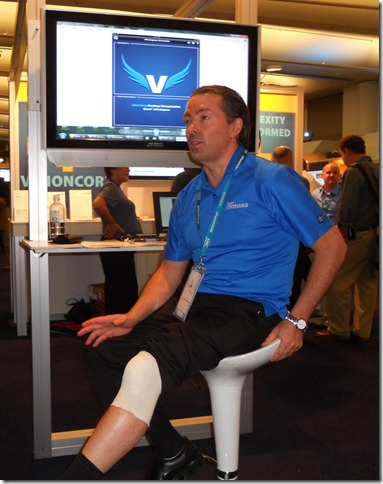
David Caddick of Quest Software wins this award for still coming to, and standing, at the Quest booth all day, after requiring four stitches in his leg this morning. David’s enthusiasm for an early jog lead him to a lacerating encounter with the back stairs.

Well done David for not giving up and being there.

The Is There Anybody Home Award

This award recognises the booth that is there but fails to deliver a visible presence of life. Is there a positive message from having a booth with nothing to deliver your message?

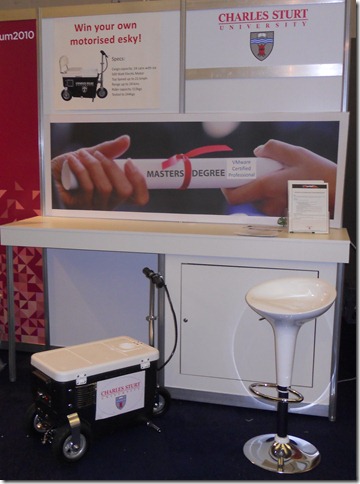
Charles Sturt university wins this award for the apparent absence of life or anything informative (apart from a mobile Esky). The presence of cold beer in said Esky would have removed this booth from eligibility for this award, alas it was a case of a pub with no beer.

Thank you, come again.

The Puritan’s Booth Babe Award.

This award is inspired by Thomas Dureya’s annual effort to decrease the amount of clothing worn by vForum Booth Babes. Our puritan family values cannot condone the use of the scantily clad female form in a male dominated event as a marketing tool, hence our award goes to the Booth Babes presenting the height of puritan values.

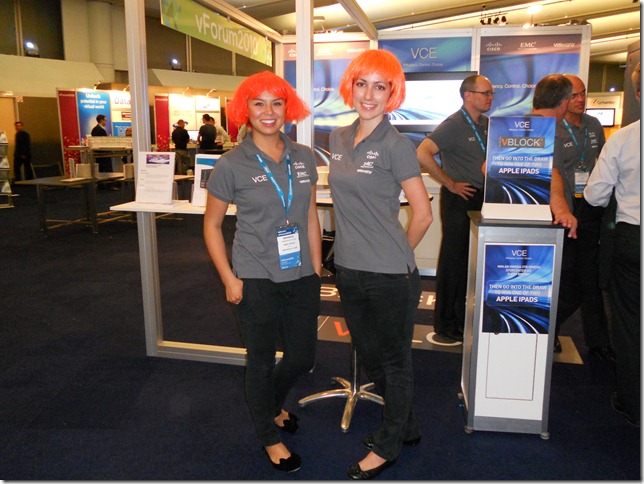
The award goes to the VCE booth where the Booth Babes were covered from ankle to neck, along with modest head coverings. This is an excellent representation of Slip, Slop, Slap that would survive even a summers day on Bondi Beach.

We are very pleased to see a number of women on booths with excellent technical knowledge, not simply Booth Babes.

Show Me The Hardware Award

This award is to recognise the hardware vendor who has failed to show their product. Attendees are all interested in viewing and discussing your wares, which is hard if there is only a brochure.

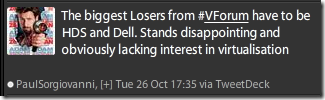
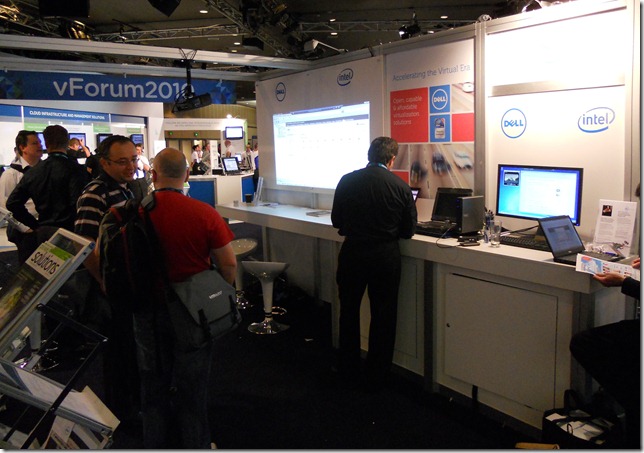
The award goes to Dell, one of the largest server and storage hardware vendors, who only had a few laptops on their stand showing powerpoint. We were not the only critics to notice the lack of tin.

Maybe it’s all in the cloud.

Bravery Award

This award goes to a vendor that has gone the furthest and taken the risks. The unkind could call them cowboys, but we call them courageous.

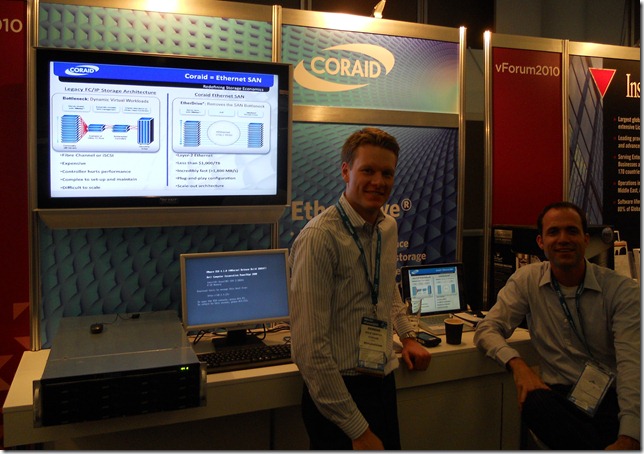
The award goes to the brave boys at CoRAID, a new entrant into the storage market in Australia. With little local sales presence and only imminent VMware HCL support they nonetheless braved the big money vendors and brought actual hardware with blinking lights. Great to see them giving it a go in this crowded space.

Bigger and better next year.

Interactive Playground Award

This award is for the booth where the geeks got to play. vForum is for engaging and learning, this award celebrates booths that do this well.

The award goes to Cisco whose booth had a structured schedule of open briefings on their products, with excellent giveaways. There were a number of blades to touch and look at their insides, the hardware wasn’t just there it was there to be investigated. There were numerous technical people who sought questions to answer.

Geeks delivering to Geeks.

Buffet Award

This award recognises the booth with the broadest range of products and solutions visible. There needs to be something for everyone and the whole family should go home having had their fill.

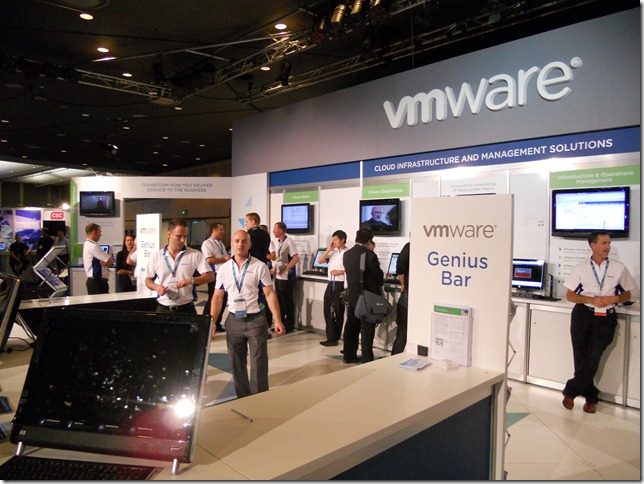
The award goes to VMware who, despite being their event, showed an enormous range of products at a detailed level, every product was actually there to be touched and used. More than a dozen products were identifiable from distance and there were experts on them all.

No one trick Pony.

Most Appealing Booth Award

This award recognises the booth that stands out and draws you to it, with so many booths it becomes a blur. Something different must greet the eye.

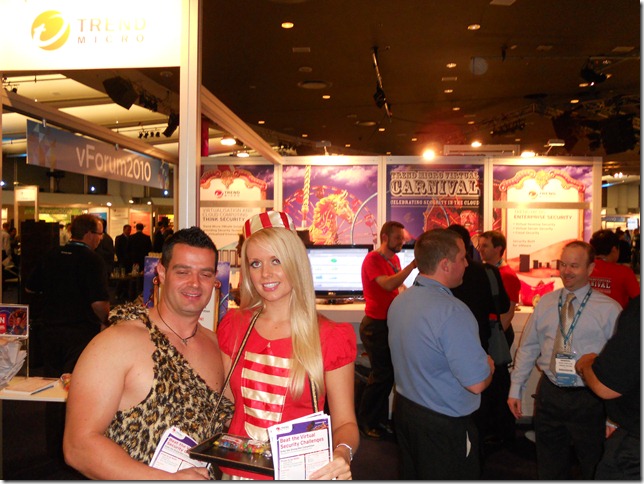
The award goes to Trend Micro for their appealing Carnival theme, from a distance you could see it wasn’t your ordinary booth. With the space limitations and sundry restrictions placed by event organisers it takes effort to stand out.

Who says conferences are all a circus?

Thanks to all the exhibitors who make the event so valuable. Congratulations to the winners. All those that didn’t make this years list should be planning for next year’s awards.

Rodos and Alastair

Dell acquiring 3PAR

Monday, August 16, 2010 Category : , , , 0

Twitter is all awash with news that Dell have acquired 3Par.


There have been a few who have been suggesting that 3Par was next on the acquisition trail. They have some good technology and certainly a more modern architecture (love those chunklets and what you can do with them).

What is also interesting is that Dell only recently went out and purchased another storage player, Ocarina. I wrote about Ocarina last year when we visited them as part of TechFieldDay. What does Ocarina do, compression for storage. Now 3Par does great thin storage but don't do compression. One wonders what of the Ocarina technologies Dell might be planning on integrating into their new purchase.

Certainly interesting times in the storage industry. The stack wars are heating up maybe?

Rodos

Stack Wars

Thursday, April 22, 2010 Category : , , , , , , 0

Stephen Foskett (http://blog.fosketts.net/ @SFoskett) has started a series over at GestaltIT on the Stack Wars topic. Stephen reached out to a few people in the blog space to see what they thought. I thought his questions were really interesting so gave it some thought (okay it was only enough thought that could be done on a bus trip to work).


To the questions.

Why is this happening?

I think a number of factors have lead to the "stack" or the return to the mainframe model.

One of these is virtualisation. Virtualisation has in many ways collapsed the different components of compute, networking and storage into a blob where differences in each individual layer are diminished. The layers are abstracted away through the hardware independence and it starts to make sense to obtain an entire "virtualisation" machine rather than build it from scratch each time.

Likewise the continue performance improvements means that these more generic solutions can solve a might greater scope of workload than ever before. Certainly the advancement in hardware processing capacity has outpaced softwares ability to consume it.

The second element is the change in behaviour of the vendors. The vendors are much more willing to get in front and sell to end users these days. Even those vendors who are so channel focused do this. I remember 10 years ago in the integration space; it was only the top of town that could get a sales person or a system engineer from a vendor to visit and flaunt their wares. These days, if you are a fish and chip shop you could probably get a vendor to turn up for a presentation and a proof of concept.

However the vendors are realising what the system integrators learnt a long time ago, there is money to be made by combining all the parts and providing a whole solution. Plus the cost of sale can drop if you can have a few packages that fit most sales, rather than doing everything as customised solutions.

The vendors have realised that by using virtualisation and stacks they can make larger sales whilst reducing their cost of sales whilst targeting an increase number of opportunities.

Is this good for end-users?

It is probably a little early to see how the benefits for end users will pan out. If we learn from history the mainframe era certainly had its drawbacks for many organisations towards the end.

There are certainly some up sides for the end users. Improved levels of support and integration can't be bad. Certainly lower costs by removing lots of customised design work and through economies of scale is going to be a benefit.

But there will be drawbacks too. I don't think anyone has been thinking or talking about the lifecycle of these stacks. Will you have to replace the entire stack each time at end of life to keep your support? What if you are happy with your compute and storage but have brought in a new networking fabric that is much faster, do you have to throw the baby out with the bathwater?

Where are IBM and Dell?

My hunch is that IBM and especially Dell are in the wings waiting to see how things pan out. Let the early adopters play and make the market, see where the success and failures are. Once they have learned from all of their mistakes they can swing in bringing in their existing value propositions. They don't want to leave it very long but we are still in the incubation period for the stacks.

I think Dell is the one to watch here rather than IBM. After all they have been essentially doing this today in the lower end of town. They have the parts to bring it together and they can suck the bottom tier right out of the market from under everyone else.

Of course HP is the other one to watch very carefully, especially now that 3Com is on board.

What about the smaller players?

If the stacks take off the smaller players are going to continue to do what they have always done, value add. Many elements of technology have turned to commodity. Remember the days when you would always pay people to come in and do Exchange deployments. Remember how hard it was to maintain Unified Communications solutions. Over time the technologies became utility enough that organisations could do these themselves.

Smaller players, whether they be systems integrators or vendors will continue to find those niche requirements and the hard projects or problems that will always be around. Our consumption of technology is growing not shrinking, the small players will continue to deliver and support the early adoption technologies.

What does this do to innovation?

Many people in IT need to understand that we are in a young industry which is starting to mature. A lot of stuff really is going to become utility and standardised, thats the way industries evolve. Yet innovation still continues in mature industries.

What about cloud?

Bingo, we can't talk about anything with mentioning Cloud. Are the stacks the vendors means of abating the move of all of the revenue to a handful of global cloud providers. Build an internal Cloud with our stack please so we can keep making some money off you.

I see the stacks working well with the Cloud, certainly the IaaS and PaaS based ones. Improved standards adoption will allow the federation and creation of meta Clouds. So there is still a place for internal work loads (there is some good thinking on this that uses the commercial property market or food production analogies).

What I DO predict we will see is the vendors offering the stacks to Enterprises is Cloud based service models for internal use. How do people consume photocopiers and printers today, they pay per page. The vendor puts in the equipment, maintains it and supplies it, you just pay for what you use. In the future we are going to see this model start to appear more in IT, once you have a utility stack, this can successfully be achieved for the vendor and the Enterprise. By the way virtualisation is the key enabler here, abstracting away all the hardware from the workloads.

Is this the ultimate form of IT infrastructure?


The word "ultimate" makes it sound like the most amazing. No, I don't think its going to be the ultimate. I think the stacks might become the boring utilities they they are meant to be. A standardised, reliable, cost effective computing block thats does what it is tasked to do, no more and no less. Its the IT version of the multi-function photocopier. Roll them in and roll them out. The stacks are more about an operational model than speeds, feeds, dials and knobs.


Well there you have it, thats enough for me to come up with on a bus trip. Be keen to hear your thoughts, post in the comments.

Rodos
Powered by Blogger.