Home > IBM

IBM

Save the date for IIIS event in August

Thursday, May 19, 2011 Category : , , , , , , , , 0

If you are based in Australia then put a note in your calendar for August 2nd and 3rd. This is the date of the first Implementing Information Infrastructure Symposium (IIIS) which will be held at the Hilton Hotel in Sydney. The event is partnership between Storage Networking Industry Association for Australia and New Zealand (SNIA ANZ) and IDG Australia.


The first round of vendors have signed up as premier partners for the event, being :
  • Cisco
  • Dell
  • EMC
  • HDS
  • HP
  • IBM
  • NetApp and
  • Symantec
There means there is going to be some great information and speakers available. However don't think this is just going to be a vendor fest. Onwards from here
IIIS is now embarking on signing up the Technology and Channel sponsorship partners. Altogether, some 40 vendors and partners will present to delegates as well as speakers from large Australian corporations, subject matter experts, and the leading industry analyst from the USA.
If you are not lucky enough to get to overseas events such as the recent EMC World or the upcoming VMworld, I think you are going to find this event very useful. Storage and information management is a massive are of interest and development at the moment.

Hopefully I will see you there!

Rodos

P.S. Note that I am a board member of SNIA ANZ so I probably have a vested interest in people attending this. But I am a geek first and still think this is a great event anyhoo!

IBM XIV

Saturday, November 06, 2010 Category : , , , 4

I posted the interview with Craig McKenna from IBM on XIV. Here is more of the details from the SNIA Blogfest event this past week.


First off Craig went through the XIV, which there has been a bit of talk about in the industry. Here is his slide on the specs.


The details from my notes were :
  • It comes in its own rack.
  • It is built up from modules, each which hold 12 SATA drives.
  • 6 modules also contain the FC (4G) and iSCSI (1G) interfaces.
  • Internally the backplane uses 1G Ethernet. Each module has four connections.
  • You can start with 6 modules, which gives you 72 disks. Maxed out at 15 modules you will have 180 drives.
  • You need to pick a standard drive size across the entire rack, it only has one tier, full stop. Either 1TB or 2TB drives. You can't match drives, if you do the additional space in the larger drives is not used. Once you have all of the drives in at the larger size, you do get the space as it rebuilds/re-levels. I don't think you can mix drives sizes within a module. Over the lifetime of the machine I wonder if customers are going to want to get the benefits of larger drive sizes. Hopefully they will have a great relationship with their IBM sales rep and can get them to trade in their old drives. Its a result of the architecture but if an XIV was the only storage on your floor it might not be flexible enough for you.
  • With the smallest drive and smallest number of modules you starting point is 27TB. The largest capacity you can go to is 161TB. These figures are for usable space after loss of data protection (mirroring) and sparing (not disk based) is factored in.
  • The read architecture makes the SATA drives perform close to FC speeds.
  • The controllers use a grid architecture, all can access and service data at the same time.
  • The cache is 240G (depending on number of modules).
  • It is always doing thin provisioning but you don't have to over provision.
  • You can put your XIV in front of your existing storage (disruptive to get it into the data path) and then get it to ingest existing data to conduct data migration.
  • Redirect on write is used used for snapshots, similar to Netapp but unlike Netapp the snap data is independent and resides outside of the volume. You can do up to 16000 snaps.
  • Async Replication is based on snapshots (not my favourite method).
  • In the future you will be able to connect multiple frames (racks) together and these could have different drive sizes. Infiniband will be used for the interconnection.
  • Data is broken into 1MB chunks and these are pseudo-random distributed across all resources in the frame as well as being mirrored. This is called RAID-X or mirrored protection.
  • The mirror of a chunk never resides on the same module. Chunks that are on one disk are not mirrored to a matching disk in another module (like a RAID mirror) but rather spread across all the other drives in the system. There is potential for data loss if two disks fail but clever maths and some other techniques are used to make this risk very low. Across the 300 [correction:3000] installations world wide there have been no double drive failures. Of course your traditional RAID systems are at risk from a double drive failure in a set too.
  • Of course with XIV the failure domain is wider if two drives were to fail. This is where rebuild speed comes in. If a disk fails only the 1MB chunks it contained need to be re-mirrored. So if the drive was only half full thats half the data to process than a more traditional RAID rebuild. As the data that has to re-mirrored is spread across all the drives in the system, as is the destination of the re-mirroed chunks, all the disks are involved in the read. This means that a re-mirror is really fast. A 1TB drive can be rebuilt in 30 minutes this way, as opposed to sometime up to 24 hours in traditional systems. The bigger your XIV system (more drives) the faster the re-mirror will be.
  • This great rebuild performance is a key advantage to RAID-X as disk drives continue to get larger.
  • No need in XIV to worry about hardware RAID or hot spare drive management. Operation is very simple, the systems takes care of it for you.
  • Licensing for all functions is included up front.
Whats my take on XIV :
  • You can't discount it. IBM acquired the technology from startup headed by Moshe Yanai who is known as the father of EMC's Symmetrix disk system.
  • Most of the vendors are moving to this commodity hardware and operational simplicity that XIV offers. The smarts is in the software and not the tin or brown spinning stuff. We are seeing more of these grid architectures and chunking of data. Traditional vendors are back filling this into their existing systems, XIV had the luxury of doing it fresh from the get go.
  • XIV looks like storage that does what it does well, but it only does one thing. The nerd knobs don't exist. I suspect that companies that uses XIV are going to be large and that it won't be the only storage sitting on their floor. At an entry point of 27TB usable its no small entry point, so there is going to be some big storage needs. Companies with this amount of data are probably going to have a wider variety of storage requirements, that XIV may not yet handle.
  • RAID-X sounds lovely but it has two drawbacks. First has the most expensive protection level, mirroring. The price is going to have to be right to compensate for the high overhead. Second, that large failure domain means you are only going to be using this for either scratch data or something you have backed up somewhere else. Yes a single drive can rebuild real fast. But IF (and its a long if) that was to happen, because the chunks are so wide spread you loose more than just the data you might on a single traditional RAID group, or none at all if the second disk was in a different RAID set. With RAID-X you may loose a bit of data from everything across the system. Thats going to be a hard one to recover from, and restoring between 27 to 162 TB of data is not going to be fast.
Would like to hear your thoughts on the XIV, post in the comments. Below is the video of Craig taking us through all of this.


Craig then went on to go through the new Sorwize V7000. They have taken the best of SVC, added RAID functionality from the DS8000 box, basically merging the two product lines to deliver a new mid-range controller.

I won't go into all the details of this. Here is the slide and its covered at the end of the video above, after XIV, if you want to watch it.


[Edit : Please see the comments for a response from Craig and some good links with further detail.]

Rodos

Interview with Craig McKenna of IBM on XIV

Category : , , , 2

Craig McKenna gave some details on XIV at the SNIA Australia Blogfest this last week. I caught up with Craig to get a quick run down on some of the things he talked about including the value prop, how data is stored via RAID-X and the technique for rebuild of failed drives.


I have the video of the actual presentation so I will process that and put it up so you can see the whole thing.

Rodos

Video from SNIA Blogfest - IBM Storage Strategy

Friday, November 05, 2010 Category : , , 0

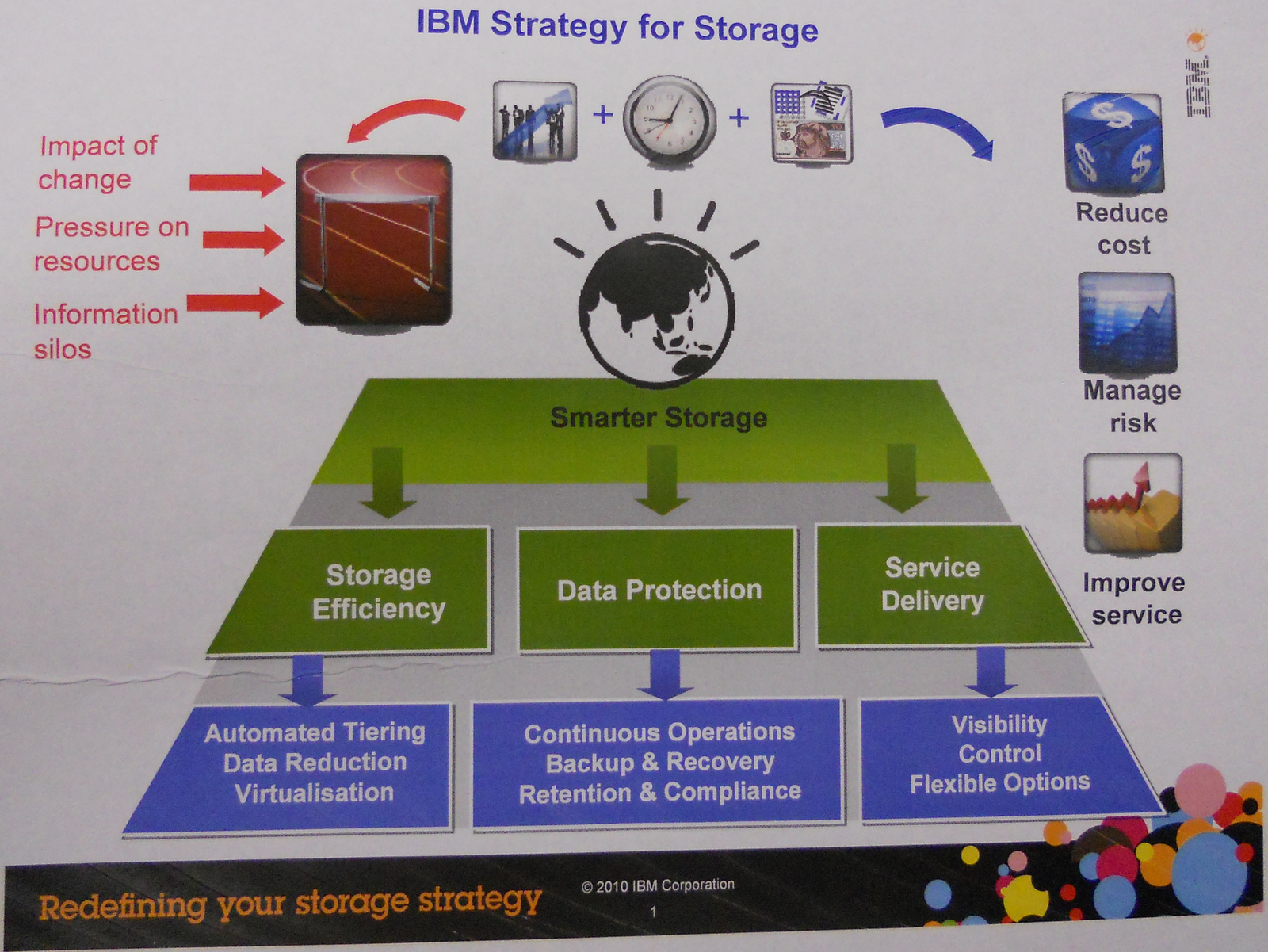
At the SNIA Australia Storage Blogfest, Anna Wells presented the IBM strategy for storage. I previously posted the brief interview we did afterwards.

Here is the full video of the presentation, which I thought was very good. I am bit of fan of white boarding a presentation myself so it was great to see someone else doing it. The structure really flowed.


Here is the final image drawn up.


Here is the version handed out afterwards.


I thought it was good that IBM found in necessary to first present their overall strategy as a place to then reference their products into. In fact a single product might address multiple areas of the strategy. It shows a good consultative approach from a vendor, not all speeds and feeds.

Rodos

SNIA Blogfest Interview with IBM

Category : , , 0

At the SNIA blogfest in Australia, Anna Wells presented the IBM strategy for storage. Anna is the Lead for IBM storage across A/NZ.


I caught up with Anna and recorded this quick interview afterwards to get a summary.


I will post up later the full video of the presentation.

Rodos

SNIA Blogfest Australia participants

Tuesday, November 02, 2010 Category : , , , , 1

This coming Thursday is the SNIA blogger event which will cover EMC, HDS, IBM and NetApp .

Bloggers who are attending are

Ben Di Qual : @bendiq
Graeme Elliott : http://itknowledgeexchange.techtarget.com/art-of-storage/ @GraemeElliott
The people presenting for the vendors are

EMC : Clive Gold @clivegold & Mark Oakey @maoakey
HDS : Adrian De Luca
IBM : Joe Cho
NetApp : John Martin @life_no_borders

Of course the host is Paul Talbut of SNIA Australia @SNIA_ANZ

Expect to see some tweets, possibly live blogging and some great blog write ups, photos and videos of the event.

I have created a twitter list of all the twitter handles that I could find, so you can easily follow the group activity. http://twitter.com/rodos/snia-blogfest-2010

Update : Justin came up with a sweet hashtag #sniafest, love it.

Rodos

Australian Storage Blogfest

Friday, October 15, 2010 Category : , , , , , 1

Are you a blogger in Australia who covers a bit of storage? If so then you will want to know that SNIA Australia is hosting a blogfest with a range of storage vendors on Thursday November the 4th in Sydney.


Its a one day tour, face to face, with the major storage vendors IBM, HDS, EMC and Netapp.

Here is what SNIA have to say about the event :
  • Bloggers benefit from a direct engagement with the key storage vendors to learn more about their technology and product strategy. With the increasing influence that bloggers have with customers it is important that authors are technically accurate and have a broad perspective of technology and the product/feature sets that differentiate the vendors. This is a unique opportunity to do a direct comparison across four major vendors in one day, at no cost other than an investment of your time.
  • Sponsors benefit from a direct engagement with key influencers about their technology and product direction/strategy. Their participation in this session can ensure their technology is well understood by those who have the influence over customer perception. This is a rare opportunity to interact directly in an open, friendly environment with these key authors.
  • The presentation sessions will be focused on technology themes determined by the bloggers themselves. The Blogfest is a one-day event with four 1.5-hour sessions. Each session includes time for technical presentation, hands-on activities and delegate discussion. We expect direct questions and feedback in return.
This should not be a dump of the latest product releases from each vendor. It will hopefully be a good discussion on storage technologies and the market. Moving from one vendor to another you can really compare and contrast on where each stand and their strengths and weaknesses.

Here is my personal recommendation for the topic for the day (which has not been accepted yet, its just an example).
“What new technologies in primary storage do you believe really gives customers better bang for their buck in the long term? What has your organisation seen and done in these areas in the last 12 months? Which new technologies do you think might not give customers the return they may think or are to risky to adopt in primary storage and explain your reasoning.”
I think there are many ways to answer that and it will be great to hear what IBM, HDS, EMC and Netapp's views are. Could be very telling. If you have an idea of a better theme or topic let me know.

The draw backs is that you can't work for a storage manufacture, bloggers must all be recognised independent writers on data storage related subjects working in Australia or New Zealand. You will need to take the day of work and if you are not in Sydney you will have to cover your own travel costs to the event (worth a flight I say). Travel throughout the day and meals are covered.

We really need to ramp up the amount of storage blogging happening in Australia and credit to SNIA and the vendors for giving this a go. Hopefully if this is successful we can get them to cover some travel costs next time around or hold it in a different city so that more people can be involved.

If you are interested, even if you are not a blogger but a person of influence in a community, then contact Paul Talbut, General Manager of SNIA ANZ with your details via paul.talbut@evito.net (or me). You never know, you may just get an invite!

I hope to see many people there!

Rodos

Stack Wars

Thursday, April 22, 2010 Category : , , , , , , 0

Stephen Foskett (http://blog.fosketts.net/ @SFoskett) has started a series over at GestaltIT on the Stack Wars topic. Stephen reached out to a few people in the blog space to see what they thought. I thought his questions were really interesting so gave it some thought (okay it was only enough thought that could be done on a bus trip to work).


To the questions.

Why is this happening?

I think a number of factors have lead to the "stack" or the return to the mainframe model.

One of these is virtualisation. Virtualisation has in many ways collapsed the different components of compute, networking and storage into a blob where differences in each individual layer are diminished. The layers are abstracted away through the hardware independence and it starts to make sense to obtain an entire "virtualisation" machine rather than build it from scratch each time.

Likewise the continue performance improvements means that these more generic solutions can solve a might greater scope of workload than ever before. Certainly the advancement in hardware processing capacity has outpaced softwares ability to consume it.

The second element is the change in behaviour of the vendors. The vendors are much more willing to get in front and sell to end users these days. Even those vendors who are so channel focused do this. I remember 10 years ago in the integration space; it was only the top of town that could get a sales person or a system engineer from a vendor to visit and flaunt their wares. These days, if you are a fish and chip shop you could probably get a vendor to turn up for a presentation and a proof of concept.

However the vendors are realising what the system integrators learnt a long time ago, there is money to be made by combining all the parts and providing a whole solution. Plus the cost of sale can drop if you can have a few packages that fit most sales, rather than doing everything as customised solutions.

The vendors have realised that by using virtualisation and stacks they can make larger sales whilst reducing their cost of sales whilst targeting an increase number of opportunities.

Is this good for end-users?

It is probably a little early to see how the benefits for end users will pan out. If we learn from history the mainframe era certainly had its drawbacks for many organisations towards the end.

There are certainly some up sides for the end users. Improved levels of support and integration can't be bad. Certainly lower costs by removing lots of customised design work and through economies of scale is going to be a benefit.

But there will be drawbacks too. I don't think anyone has been thinking or talking about the lifecycle of these stacks. Will you have to replace the entire stack each time at end of life to keep your support? What if you are happy with your compute and storage but have brought in a new networking fabric that is much faster, do you have to throw the baby out with the bathwater?

Where are IBM and Dell?

My hunch is that IBM and especially Dell are in the wings waiting to see how things pan out. Let the early adopters play and make the market, see where the success and failures are. Once they have learned from all of their mistakes they can swing in bringing in their existing value propositions. They don't want to leave it very long but we are still in the incubation period for the stacks.

I think Dell is the one to watch here rather than IBM. After all they have been essentially doing this today in the lower end of town. They have the parts to bring it together and they can suck the bottom tier right out of the market from under everyone else.

Of course HP is the other one to watch very carefully, especially now that 3Com is on board.

What about the smaller players?

If the stacks take off the smaller players are going to continue to do what they have always done, value add. Many elements of technology have turned to commodity. Remember the days when you would always pay people to come in and do Exchange deployments. Remember how hard it was to maintain Unified Communications solutions. Over time the technologies became utility enough that organisations could do these themselves.

Smaller players, whether they be systems integrators or vendors will continue to find those niche requirements and the hard projects or problems that will always be around. Our consumption of technology is growing not shrinking, the small players will continue to deliver and support the early adoption technologies.

What does this do to innovation?

Many people in IT need to understand that we are in a young industry which is starting to mature. A lot of stuff really is going to become utility and standardised, thats the way industries evolve. Yet innovation still continues in mature industries.

What about cloud?

Bingo, we can't talk about anything with mentioning Cloud. Are the stacks the vendors means of abating the move of all of the revenue to a handful of global cloud providers. Build an internal Cloud with our stack please so we can keep making some money off you.

I see the stacks working well with the Cloud, certainly the IaaS and PaaS based ones. Improved standards adoption will allow the federation and creation of meta Clouds. So there is still a place for internal work loads (there is some good thinking on this that uses the commercial property market or food production analogies).

What I DO predict we will see is the vendors offering the stacks to Enterprises is Cloud based service models for internal use. How do people consume photocopiers and printers today, they pay per page. The vendor puts in the equipment, maintains it and supplies it, you just pay for what you use. In the future we are going to see this model start to appear more in IT, once you have a utility stack, this can successfully be achieved for the vendor and the Enterprise. By the way virtualisation is the key enabler here, abstracting away all the hardware from the workloads.

Is this the ultimate form of IT infrastructure?


The word "ultimate" makes it sound like the most amazing. No, I don't think its going to be the ultimate. I think the stacks might become the boring utilities they they are meant to be. A standardised, reliable, cost effective computing block thats does what it is tasked to do, no more and no less. Its the IT version of the multi-function photocopier. Roll them in and roll them out. The stacks are more about an operational model than speeds, feeds, dials and knobs.


Well there you have it, thats enough for me to come up with on a bus trip. Be keen to hear your thoughts, post in the comments.

Rodos

Powered by Blogger.