Home > VCE

VCE

vForum Sydney Solution Exchange Booth Awards

Tuesday, October 26, 2010 Category : , , , , 0

In the tradition of social media we bring you the first ever (and possibly last) vForum booth awards. Success is based on a top secret criteria of awarding points in several random and sarcastic categories, as well as a little honest opinion.

Rodney Haywood and Alastair Cooke (@DemitasseNZ /www.demitasse.co.nz ) have dedicated minutes of their time to bringing you the best and worst of the booths, saving your the arduous journey through the crowds.

In no particular order, our awardees are:

Dedication to Booth Duty Award

Not a booth award, this is a personal award for the person who has shown outstanding effort above and beyond the call of duty.

David Caddick of Quest Software wins this award for still coming to, and standing, at the Quest booth all day, after requiring four stitches in his leg this morning. David’s enthusiasm for an early jog lead him to a lacerating encounter with the back stairs.
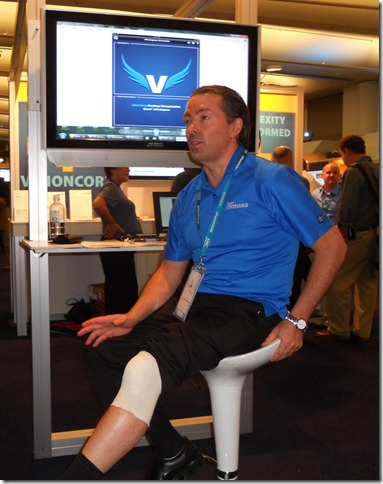
Well done David for not giving up and being there.

The Is There Anybody Home Award

This award recognises the booth that is there but fails to deliver a visible presence of life. Is there a positive message from having a booth with nothing to deliver your message?

Charles Sturt university wins this award for the apparent absence of life or anything informative (apart from a mobile Esky). The presence of cold beer in said Esky would have removed this booth from eligibility for this award, alas it was a case of a pub with no beer.
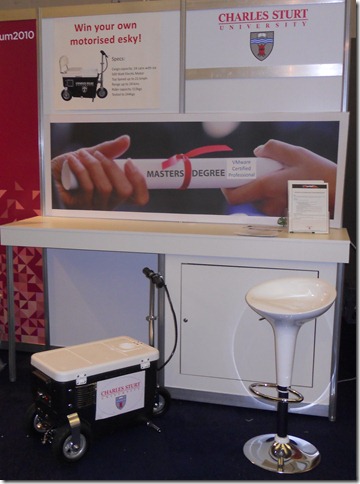
Thank you, come again.

The Puritan’s Booth Babe Award.

This award is inspired by Thomas Dureya’s annual effort to decrease the amount of clothing worn by vForum Booth Babes. Our puritan family values cannot condone the use of the scantily clad female form in a male dominated event as a marketing tool, hence our award goes to the Booth Babes presenting the height of puritan values.

The award goes to the VCE booth where the Booth Babes were covered from ankle to neck, along with modest head coverings. This is an excellent representation of Slip, Slop, Slap that would survive even a summers day on Bondi Beach.
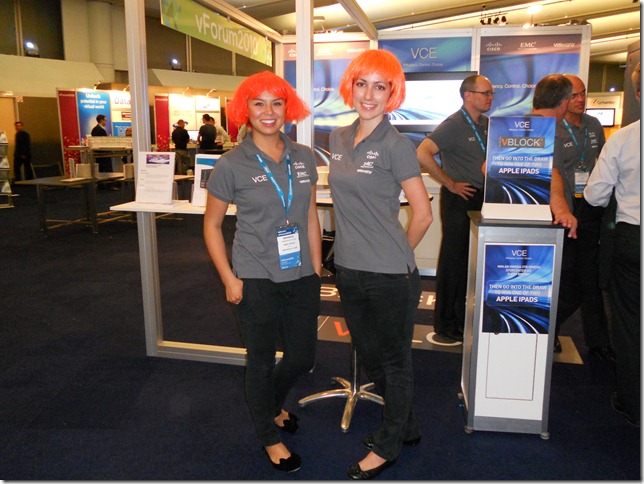
We are very pleased to see a number of women on booths with excellent technical knowledge, not simply Booth Babes.

Show Me The Hardware Award

This award is to recognise the hardware vendor who has failed to show their product. Attendees are all interested in viewing and discussing your wares, which is hard if there is only a brochure.

The award goes to Dell, one of the largest server and storage hardware vendors, who only had a few laptops on their stand showing powerpoint. We were not the only critics to notice the lack of tin.
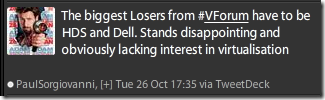
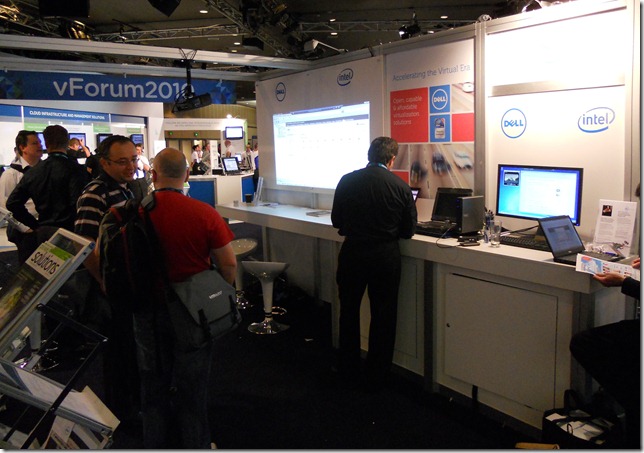
Maybe it’s all in the cloud.

Bravery Award

This award goes to a vendor that has gone the furthest and taken the risks. The unkind could call them cowboys, but we call them courageous.

The award goes to the brave boys at CoRAID, a new entrant into the storage market in Australia. With little local sales presence and only imminent VMware HCL support they nonetheless braved the big money vendors and brought actual hardware with blinking lights. Great to see them giving it a go in this crowded space.
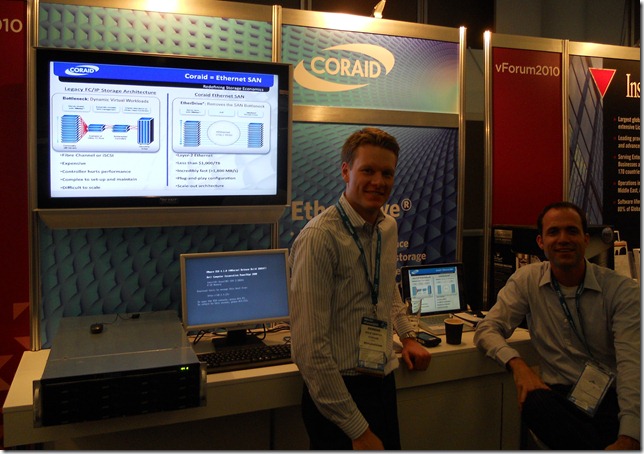
Bigger and better next year.

Interactive Playground Award

This award is for the booth where the geeks got to play. vForum is for engaging and learning, this award celebrates booths that do this well.

The award goes to Cisco whose booth had a structured schedule of open briefings on their products, with excellent giveaways. There were a number of blades to touch and look at their insides, the hardware wasn’t just there it was there to be investigated. There were numerous technical people who sought questions to answer.

Geeks delivering to Geeks.

Buffet Award

This award recognises the booth with the broadest range of products and solutions visible. There needs to be something for everyone and the whole family should go home having had their fill.

The award goes to VMware who, despite being their event, showed an enormous range of products at a detailed level, every product was actually there to be touched and used. More than a dozen products were identifiable from distance and there were experts on them all.
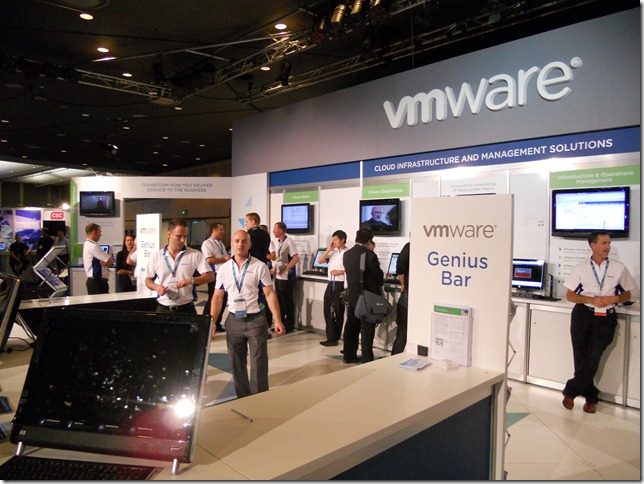
No one trick Pony.

Most Appealing Booth Award

This award recognises the booth that stands out and draws you to it, with so many booths it becomes a blur. Something different must greet the eye.

The award goes to Trend Micro for their appealing Carnival theme, from a distance you could see it wasn’t your ordinary booth. With the space limitations and sundry restrictions placed by event organisers it takes effort to stand out.
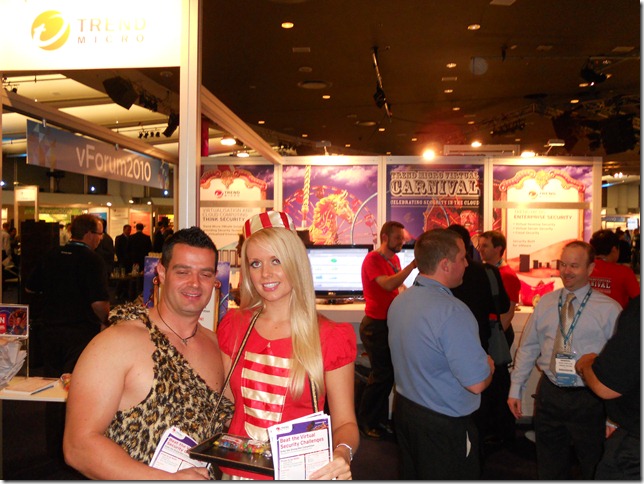
Who says conferences are all a circus?

Thanks to all the exhibitors who make the event so valuable. Congratulations to the winners. All those that didn’t make this years list should be planning for next year’s awards.

Rodos and Alastair

Cisco sells over 400 UCS systems and executives bullish on VCE

Saturday, February 06, 2010 Category : , , , 0

Cisco had their quarterly quarter earnings call a few days ago [transcript care of Seeking Alpha]. These things are really interesting and I am starting to follow them. The senior people give some good summary of they latest goings on in their company and the analysts usually ask some good questions.


A few comments were made about Cisco UCS.
  • Chambers : "Our UCS numbers are still in the early stage of customer acceptance and palettes, but again showed sequential (inaudible) rates of over 100% and now over 400 customers have ordered from Cisco."
  • Chambers : "So in terms of the datacenter area we're starting to win the architectural battles, you're seeing the value on BTE with EMC and BM where you're seeing that it isn't about server standalone technology. We have no interest in that, but architectural plays. We're off to a good start. "
Interesting, 400 customers of which some would be large and some small purchases (remember how much UCS kit was at VMworld last year!). Also that the top brass view UCS as an architectural play. Interesting to see the reference to VCE (I think the BTE and BM are transcript errors for VCE and VM). Its not about isolated server technology.

There was a longer question and answer on UCS.
Richard Gardner – Citigroup

Okay great. Well, most of my questions have been answered, but I did want to ask you where you're seeing the most success in UCS? You're obviously on a pretty good trajectory there quarter to quarter. Where are you seeing the most success in terms of applications in workloads? Can you talk about who you go up against most often in competitive bidding situations? And why customers choice UCS over competing products when they (inaudible) as your product?

John T. Chambers

Let me take a little bit of cut at it, but I want to also not mislead you. We’re just up to 400 customers. Most of those are doing pilots and implementation. How the first couple dozen go in the big account service providers and enterprise to determine how your next wave goes. Why we’re winning, it’s an architectural play. I (inaudible) it’s a very well class product which in my opinion one that is well ahead of our competitors at this point in time. But it’s the architecture and how the network and possessing capability and storage capability comes together with the applications and the cloud. And the ability to build the architectures where many of the costumers are doing net.

Others are doing it and we’ve been surprised a little bit we’re off in the commercial market play with some real leading edge commercial customers just saying, hey, you save so much in terms of my splurge costs. So much in flexibility and you’re headed to where you’re going to go without locking me in and best in class products in each category. We’re going to line with you.

I probably would say, I would poll a discussion on tele-presences for the next quarter call. We’re probably two quarters out from being able to do the same meaningful discussion on the UCS side of the house. So what I think you can say is that we’re not only holding our own in the data center and virtualization. Padma, what you started with Cloud and what we’re really driving through, we’re having very good success with.
So early implementations of UCS have gone into big service providers and enterprise. How the early implementations succeed is key for ongoing success. Again mention of UCS being an architectural play with reference of how it is networking, processing and storage combining to deliver applications and Cloud.

Certainly looks like the stack is important to the executives at Cisco.

I wondered if it was the same over at EMC, so I dug up their latest earnings transcript. Asking about pipelines William Fearnley asked Joe Tucci "where are the bright spots here when you look across the world for 2010?" The second element to the answer was :
I think there are a lot of opportunities on the back of our partnerships with Cisco and VCE, and revitalizing our DELL partnership; I think those two are massive opportunities for us if we do them right, and I believe we can do them both right. Of course, as we really get into this next generation of how we take the cloud computing and really bring it, internal or private cloud market is going to be a big, big, big opportunity for us and how we really execute on that is phenomenal.
So Tucci is thinking the same as Chambers, VCE, big opportunities and Cloud. I suspect these guys are probably smarter than you or I. If they are betting big something might just be in this. Then of course, maybe they have just spent "big, big, big" money and they want some "big, big, bigger" return on their investment.

Rodos

UCS local disk policy + some vBlock

Friday, February 05, 2010 Category : , , , , 5

I have been reading through all of the VCE vBlock reference documents that were recently published as announced by Chad. The last thing we want is for our implementation to be forked, away from the blessed best practices. [jump to the end for brief comments on the guides, this post is about something else]

In the deployment guide it details various UCS manager policies that should be created, I noticed that it specifies creating a "Local Disk Configuration Policy" set to "No Local Storage". The default is for any configuration.


Sidebar - Local disk configuration policy explained.
What the Local Disk Configuration Policy does it configure up the installed disks in your blades as the service profile is deployed to them. Forget going into the BIOS and setting things up, this is virtual hardware and stateless computing people. You just pick a policy, of say RAID Mirror, and when your server profile is applied to the blade it configures the RAID controller automatically. As an aside, you can also have local storage qualifications to even say what size disk you want, so you can deploy your server profile asking it to find a spare blade that matches your requirements.
The reason why I noticed it was because this caught me out during deployment/testing. When it means No Local Disk it really means no disk. We started with this exact"No Local Disk" policy. During some deployment we noticed that no spare blades could be found. After a short time of head scratching we realised that the only blades left were some that had local disks. Its a true testament to stateless computing when you start to forget what hardware you have and where it is, just letting the systems consume it for you. A quick change to a policy of any configuration and it was off and deploying again.

Of course I am going to put the policy back the way it was eventually (when we pull the drives out of that set of machines), here is why :
  • Security - To perform stateless computing you are booting from SAN and local disks are usually not required. The only case would be local scratch disk that was transient. You don't want to be writing data to the local storage and then for some reason redeploy your server profile onto another blade, leaving that data behind, bad security move.
  • Scrub Policy - Those who know a bit about UCS may say, "Rodos, just create a Scrub Policy". A Scrub Policy scrubs the disk so that a subsequent service profile has clean disks. Problem is that its not effective. Not being one to trust anything I dug into how it scrubs, all it does is overwrite the start of the disk with some zeros, it does not scrub the whole disk with multiple passes. Its a future function to make it a more secure scrub but as it is now I bet you could somehow get at that data.
So my recommendation which concurs with the vBlock guidelines is. Boot from SAN, set a No Local Storage policy and let the automation of UCS stateless computing take care of things for you.

Rodos

P.S.

My thoughts on the VCE vBlock guides themselves. I have skimmed through them all, initial impressions. Of course I will send some notes to those inside the VCE organisation through channels but I figured people would be interested. Reading the VCN (Netapps) document is on my list too, will be interesting to compare.
  • Don't think these will do your work for you. They leave more as an "exercise for the reader" than you might think. Its not a design of your system and you are going to have to do some significant work to create a solution. I know, I have just done it.
  • There is a lot of detailed information in the deployment guide about UCS and UCSM, very detailed. There is a bit about the EMC storage and a token amount on VMware. Sure it is not a very fare comparison because its easy to describe and detail how to build up the UCS system, whereas in contrast its not like you can describe laying out a VMax in 20 pages. Also the VMax design and implementation service comes with the hardware anyway. The VMware component consists of how to install ESX, not a mention of vCenter Server. Nothing about setting up N1K and its VSMs or PowerPath/VE etc even though they are a requirement of the architecture. Not saying that should be there in detail, but you are not deployed without it and its not even mentioned. Contrast this to the UCS blade details which has every screenshot on how to check the boot from SAN has been assigned correctly in the BIOS.
  • My gut feeling is that no one from VMware really contributed to this, it was a Cisco person who did the VMware bits and EMC did theirs.

Powered by Blogger.